About Aculus tetanothrix (Nalepa, 1889)
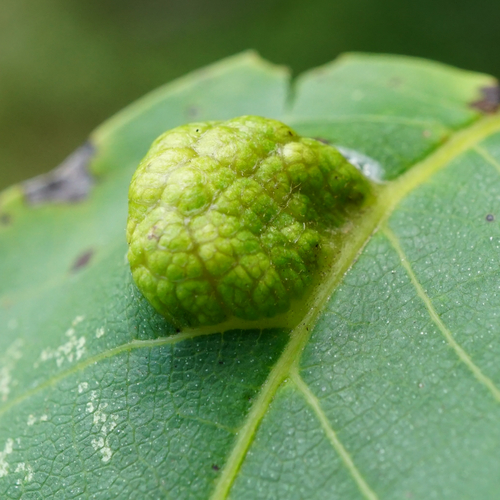
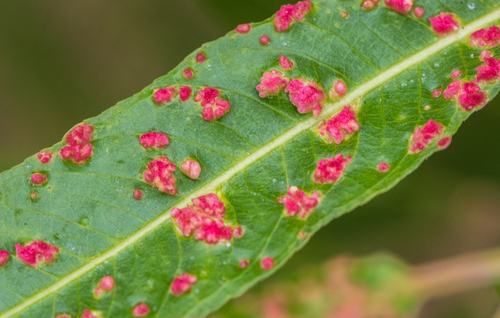
Aculus tetanothrix (Nalepa, 1889) induces plant galls on the leaves of various willow species (Salix). The gall it produces is a green or reddish, rounded pouch or pustule that forms on the upper surface of a leaf and also protrudes from the leaf's lower surface. A slit-like opening is located on the underside of the leaf; when the gall reaches maturity, the inner surface of this opening is hairy, though the hairs do not extend outside the gall. Many mites can be observed within this opening. These galls have been recorded on the following willow species: white willow (Salix alba), eared willow (Salix aurita), grey willow (Salix cinerea), Salix eriocephala, crack willow (Salix fragilis), Salix integra, bay willow (Salix pentandra), purple willow (Salix purpurea), Sitka willow (Salix sitchensis), Salix smithiana, almond willow (Salix triandra), and common osier (Salix viminalis). Aculus tetanothrix may be part of a group of closely related species, and galls found on Salix alba could instead be induced by the related species Aculus salicisalbae. Confirmed records of Aculus tetanothrix exist from Germany, Slovenia, Great Britain (including England, Scotland, and Wales), the Netherlands, Norway, Russia, Sweden, and the USA.