About Aculops fuchsiae Keifer, 1972
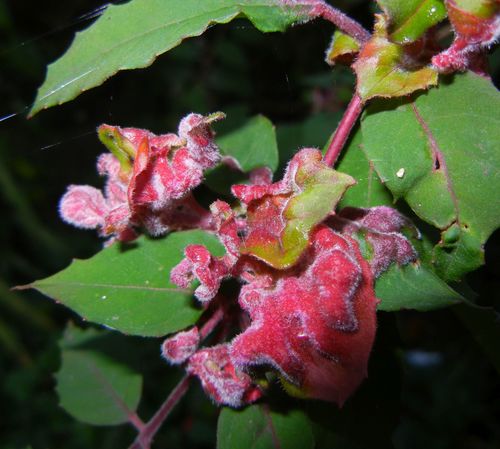
Aculops fuchsiae Keifer, 1972 is too small to be visible to the naked eye. Adult female mites measure 200 to 250 micrometres (0.20 to 0.25 mm) long and 55 to 60 micrometres (0.055 to 0.060 mm) wide, while males are slightly smaller. These mites are white or pale yellow, have a wormlike or spindle-shaped body, and have two pairs of legs on their anterior (front) end. This mite was first discovered in 1971 on Fuchsia species in São Paulo, Brazil, and was formally described the following year in 1972. It was introduced to California in 1981, and rapidly spread to colonize the southern part of the state starting from its introduction site near San Francisco. The United Kingdom's Food and Environment Research Agency states the mite was likely introduced to Europe in 2001 or 2002 on Fuchsia cuttings illegally brought from South America by a Fuchsia enthusiast based in Jersey. In 2002, it was observed at the Festival de Trévarez in Brittany, growing on a Fuchsia plant brought in by a private Fuchsia collector. In December 2003, the mite was confirmed present at eight separate sites in Brittany. It was identified on the Channel Islands in 2006, and was first found in two private gardens in southern England in 2007; it has since been detected in multiple additional locations across southern England. Different Fuchsia species and cultivars have different levels of susceptibility to infestation by this gall mite. While all Fuchsia plants can act as hosts for the mite, some experience far less damage from infestation. To date, observed mite prevalence and trial testing indicate that Fuchsia species and cultivars belonging to the Central American native taxonomic groups Schufia and Encliandra are generally resistant to infestation, while those in the Quelusia and Procumbentes groups are generally susceptible. The most susceptible species are Fuchsia magellanica, F. coccinea and F. procumbens. F. denticulata, F. gehrigeri, F. macrophylla and F. triphylla are slightly less susceptible. Documented resistant species include F. microphylla (including F. microphylla subsp. hidalgensis), F. thymifolia, F. venusta, F. boliviana, F. minutiflora, F. radicans and F. tincta. Sources do not agree on the susceptibility status of F. arborescens, which has been classified as very susceptible, fairly susceptible, or resistant by different sources.