About Actitis macularius (Linnaeus, 1766)
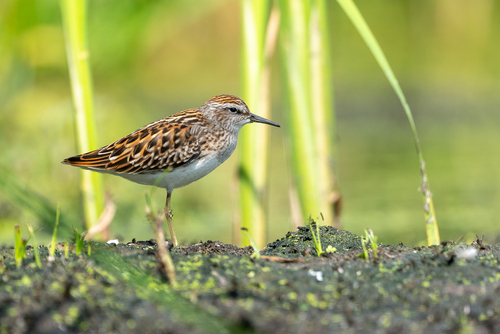
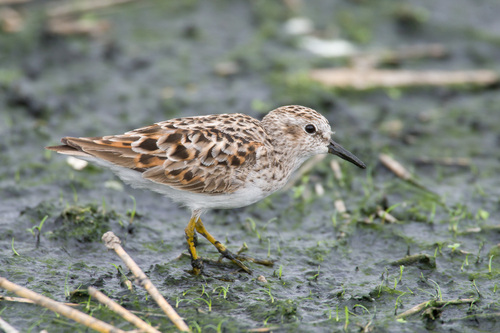
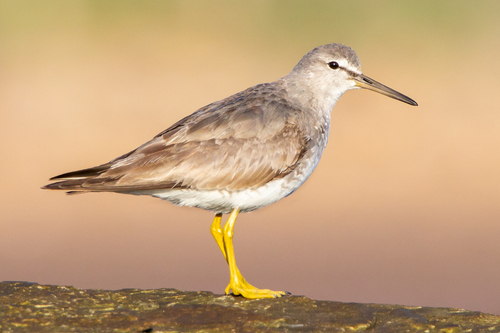
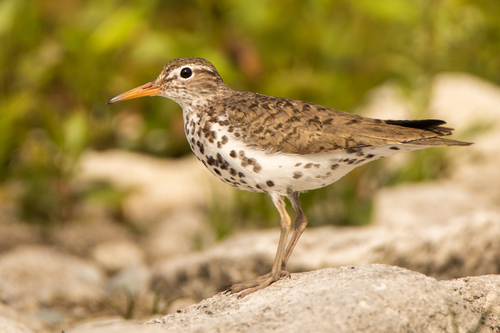
Adult spotted sandpipers (Actitis macularius) have short yellowish legs and an orange bill with a dark tip. Their upper bodies are brown, and their white underparts are marked with black spots. The extent of these spots changes over the course of a spotted sandpiper's life, and becomes especially prominent during the breeding season. An individual's level of "spottiness" may indicate its overall health: generally, females with more spots are healthier than females with fewer spots. It has not yet been determined whether spot amount correlates with condition in males. As spotted sandpipers age, their individual spots become smaller and grow more irregular in shape. Spotted sandpipers also have a white supercilium. Non-breeding spotted sandpipers do not have spotted underparts, and are very similar to the Eurasian common sandpiper. The main differences are that spotted sandpipers have a more washed-out wing pattern in flight, and normally have light yellow legs and feet. Members of the genus Actitis, including spotted sandpipers, have a distinctive stiff-winged flight that stays low over water. They also have a distinctive walking style where their tails bob up and down. Males and females have similar physical measurements, but differ in weight: females are typically 20-25% heavier than males. This species has a recorded length of 7.1-7.9 in (18–20 cm), weight of 1.2-1.8 oz (34-50 g), and wingspan of 14.6-15.8 in (37–40 cm). Spotted sandpipers are a philopatric species. Their breeding habitat is located near fresh water across most of Canada and the United States. They migrate to the southern United States, the Caribbean, and South America, and are very rare vagrants to western Europe. They are not gregarious birds, and are seldom seen in flocks. Due to their high breeding rates and ability to adapt to various environmental pressures, spotted sandpipers are the most widespread species of their kind in North America. Spotted sandpipers forage on the ground or in water, picking up food by sight. They may also catch insects while in flight. Their diet includes insects (such as flies, beetles, grasshoppers, mayflies, midges, crickets, and caterpillars), crustaceans, other invertebrates (such as spiders, snails, other molluscs, and worms), small fish, and carrion. As they forage, they can be recognized by their constant nodding and teetering movement.