About Actitis hypoleucos (Linnaeus, 1758)
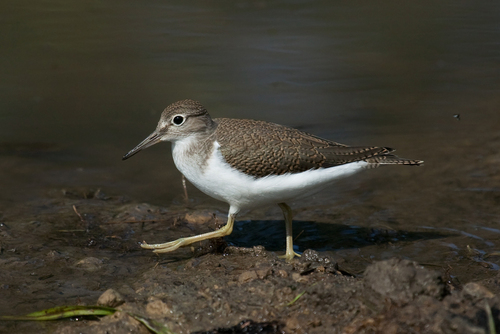
Adult common sandpipers (Actitis hypoleucos) measure 18–20 cm (7.1–7.9 in) in length, with a wingspan of 32–35 cm (13–14 in). They have greyish-brown plumage on their upperparts, white underparts, short dark-yellowish legs and feet, and a bill that is pale at the base and dark at the tip. In winter plumage, their overall coloration is duller, and they show more noticeable barring on the wings, though this barring is still only visible when viewed at close range. Juvenile common sandpipers have heavier barring on their upperparts, and buff-colored edges on their wing feathers. This species is extremely similar in non-breeding plumage to the slightly larger spotted sandpiper (Actitis macularia). It can usually be distinguished by its darker legs and feet, and its sharper, clearer wing pattern that is visible in flight; the two species also only rarely occur in the same geographic area. The common sandpiper breeds across most of temperate and subtropical Europe and Asia, and migrates to Africa, southern Asia, and Australia to spend the winter. The eastern edge of its migration route passes Palau in Micronesia, where hundreds of common sandpipers may gather to stop over. The birds depart the Palau region to travel to their breeding grounds between the last week of April and the first week of May. Common sandpipers are most often found alone, and are occasionally seen in small groups. Larger flocks sometimes form during migration, or at roosts during the breeding season. This species rarely joins flocks that contain multiple other bird species. It has a distinctive flight style, with stiff wings held low over the water.