About Actinothoe sphyrodeta (Gosse, 1858)
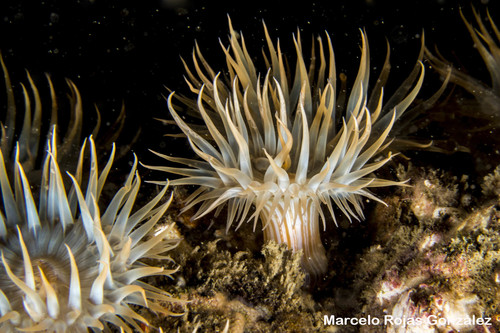
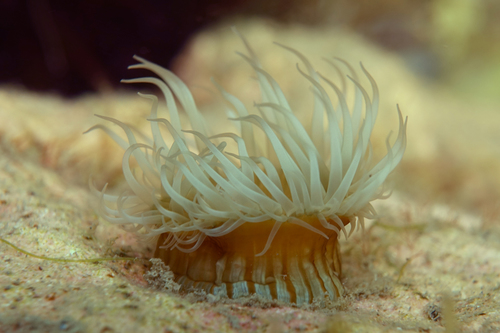
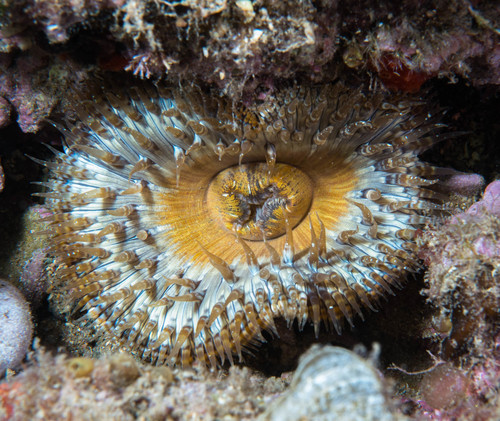
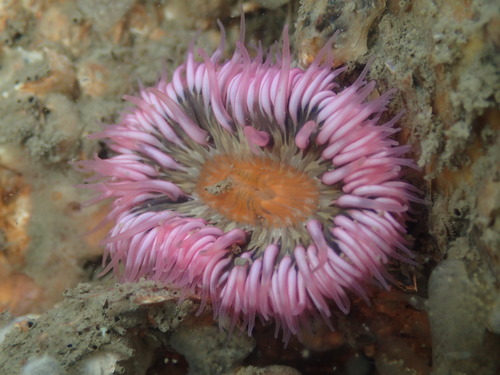
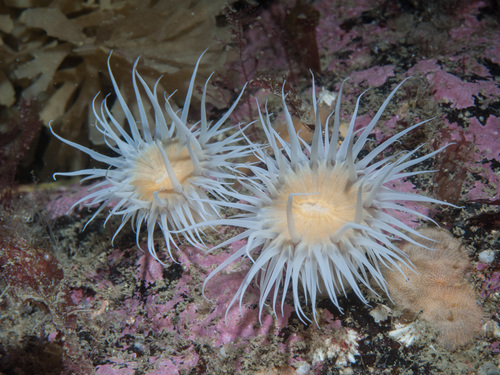
Actinothoe sphyrodeta is a small, delicate sea anemone. Its base reaches about 1 cm (0.4 in) in diameter, and the anemone often looks plump and squat. However, its column can extend to 3 cm (1.2 in) in length, and its oral disc can expand to 2 cm (0.8 in) in diameter. The column is smooth, and has a number of cinclides that appear as dark slits on its upper section. It does not have adhesive suckers. Up to 120 irregularly arranged, moderately long tentacles grow in five whorls along the edge of the oral disc. Acontia, stinging threads from the gastrovascular cavity, can be easily expelled through the mouth located at the center of the oral disc. The column is pale grey, the oral disc is white or orange, and the tentacles are white with grey bases. This species can be told apart from similarly colored variants of Sagartia elegans by the longitudinal white striations on its column and its lack of suckers.
Actinothoe sphyrodeta is common around the British Isles, and also occurs on the Atlantic coast of France. Around the British Isles, it is common in the north, west, and south, as well as around Ireland, but it is uncommon on the east coast of Scotland and England. Its northern range likely extends to the southern part of the North Sea, and it occurs at least as far south as the Bay of Biscay. It grows in caves, under overhangs, on rock walls, and on brown seaweeds including Laminaria fronds and Himanthalia elongata buttons. It can occasionally be found on the lower shore, but it is mostly a sublittoral species that lives at depths down to about 50 m (164 ft).
Actinothoe sphyrodete reproduces via longitudinal fission. During this process, the base lengthens along one plane, the two halves of the base pull away from each other, and the tissue between them tears; often the base and oral disc rupture first. The two resulting fragments may be different sizes, but both usually retain sections of the base, throat, oral disc, and tentacle ring. The wounds heal, forming two separate new individuals. This sea anemone is often found living alongside the jewel anemone (Corynactis viridis) and the Devonshire cup coral (Caryophyllia smithii).