About Actinostella flosculifera (Le Sueur, 1817)
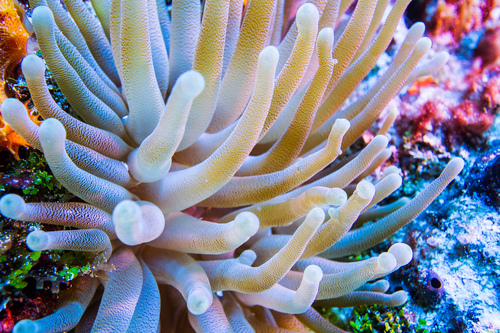
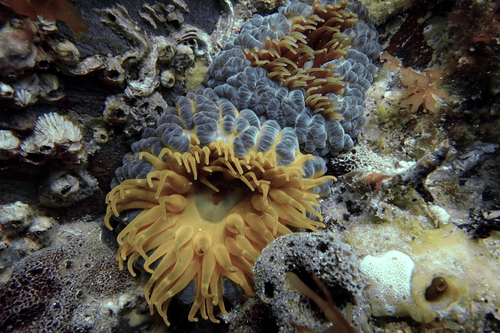
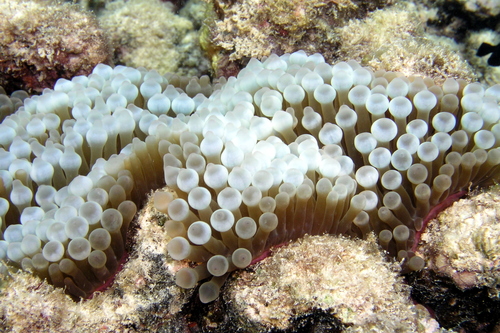
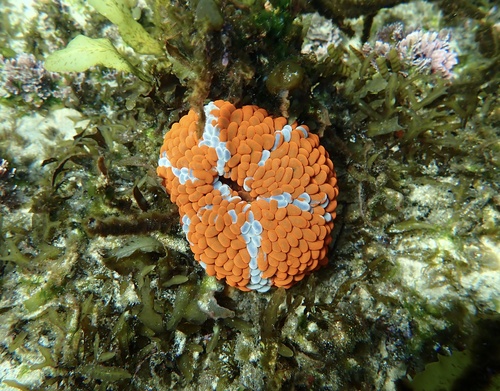
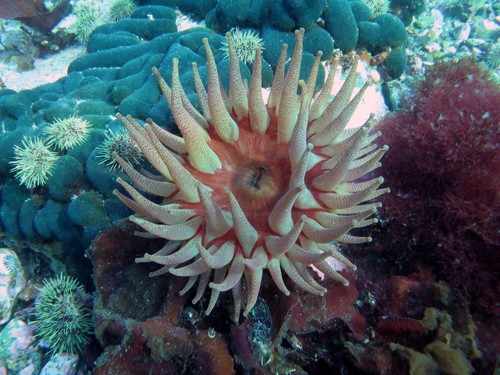
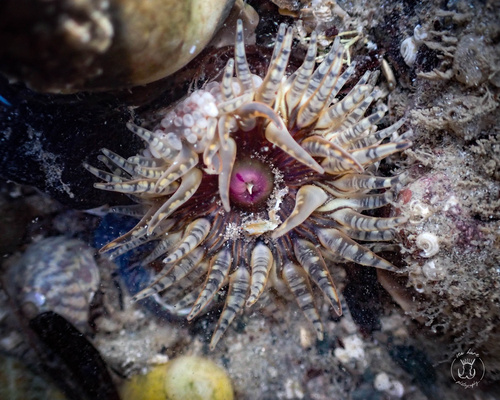
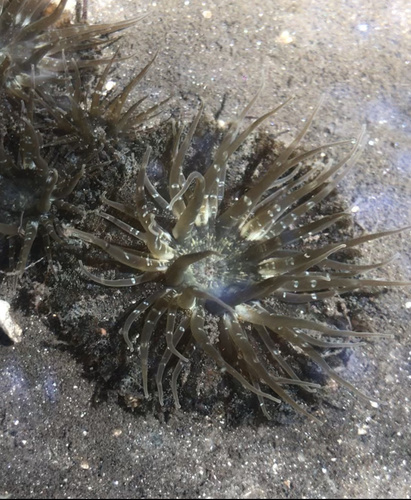
Actinostella flosculifera is a species of sea anemone. Normally, only its oral disc is visible, lying flat against the seabed, while its tall cylindrical column remains buried in surrounding sediment. The column is cream or pink, and its upper section has sticky warts that trap pieces of gravel and shell fragments. The oral disc can grow up to 7 cm (3 in) in diameter, and bears four whorls of pointed, retractable tentacles around a funnel-shaped mouth; outer tentacles are shorter than the inner ones. The outer portion of the disc forms a collar-like ruff, which bears irregular fleshy tubercles. These tubercles are pierced by fine pores, and are separated by slender radial lines. The disc can be beige, pinkish, brown or grey, sometimes marked with green bands, and its colour and texture closely match the surrounding sediment. The tentacles are translucent, and may have white spots. Symbiotic zooxanthellae live in this sea anemone's tissues, and are particularly abundant in the collar region.
Actinostella flosculifera is widely distributed in shallow tropical and subtropical waters of the Atlantic Ocean. In the Eastern Atlantic, its range extends from the Canary Islands and Madeira south to São Tomé and Príncipe. In the Western Atlantic, it can be found around the Bahamas, Bermuda, and the West Indies, and ranges south to the coast of Brazil. Its column burrows into sand, gravel or silt, and the species occurs at depths down to about 5 m (16 ft). It is typically found in meadows of Thalassia testudinum and Syringodium filiforme, in lagoons and on reef flats with minimal wave action.
The foot of the column is usually anchored to a hard substrate such as a rock, a shell, or a seagrass rhizome, while the oral disc rests flat on the sediment surface. During the day, the tentacles are contracted and the collar expands to expose its zooxanthellae to maximum sunlight for photosynthesis; the greenish-brown colour of the collar resembles fragments of dead seagrass, which may provide camouflage. At night, the tentacles expand to catch plankton and organic particles, and the collar contracts. At the slightest disturbance, the entire column contracts, and the sea anemone pulls itself out of sight beneath the sediment. This species emits two distinct types of faecal pellets through its mouth: one type holds normal digestion end-products, while the other contains zooxanthellae debris coated in mucus. The second type of pellet continues to be produced even when the sea anemone is starved of planktonic food, which suggests that this anemone's diet may be primarily based on digesting the zooxanthellae that live in its tissues.