About Actinopyga varians (Selenka, 1867)
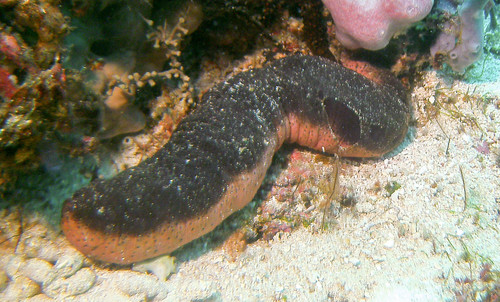
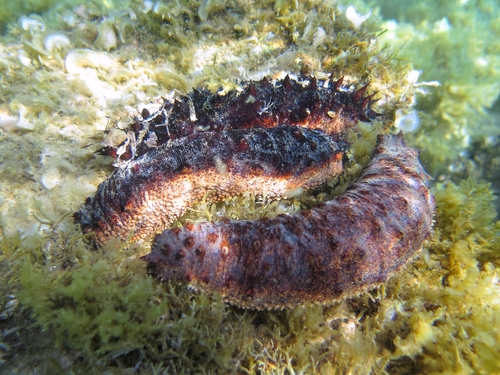
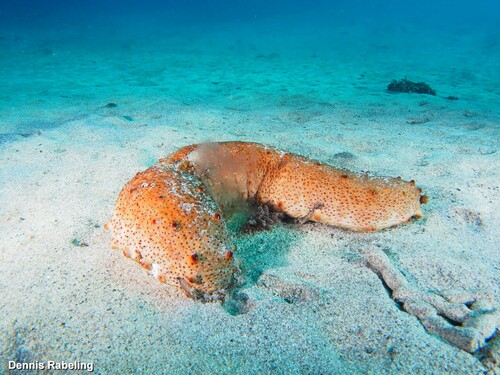
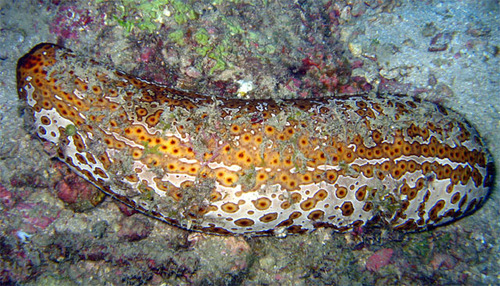
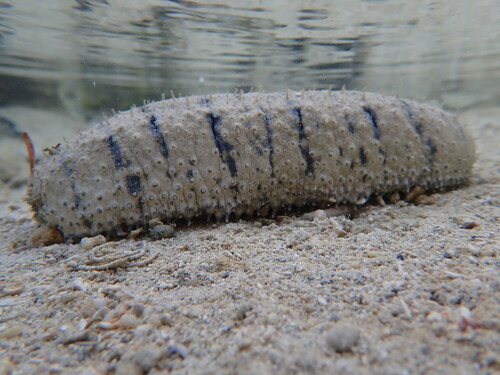
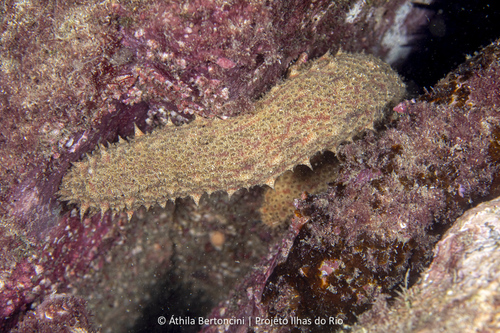
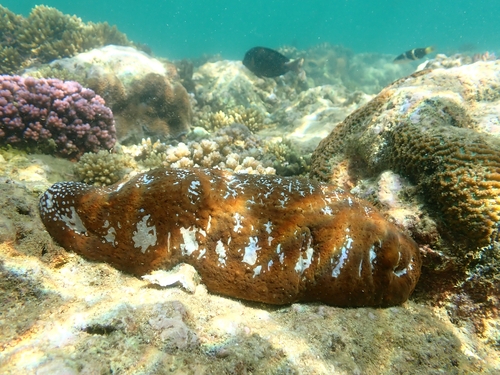
Actinopyga varians (Selenka, 1867) grows between 15 cm and 20 cm (6 to 8 inches) in length. Its bivium (dorsal body surface) is hard, wrinkled, and dark red or brown, with distinct white spots. Like all sea cucumbers (holothuroids), this species has a reduced skeleton made of isolated ossicles embedded in the body wall. A common trait of the Actinopyga genus is the presence of tooth-like structures surrounding the anus, though this characteristic is not unique to the genus, as some Holothuria species have similar structures. A. varians belongs to the Holothuriidae family, whose members are characterized by thick fleshy bodies and rows of tube feet. Blunt projections called papillae cover the animal's body, and its spicules are tube-shaped. While most Holothuriidae species can eject cuvierian tubules for self-defense, all members of the Actinopyga genus, including A. varians, cannot do this. Holothuriidae is part of the order Holothuriida, whose defining characteristic includes leaf-like tentacles surrounding the mouth that help with feeding. A. varians occurs in tropical waters of the Western Pacific and Indo-Pacific, and has been recorded in Hawaii, Fiji, French Polynesia, and other islands in Micronesia. It typically inhabits depths of 0 to 25 meters, living on living corals and surrounding rubble areas of reef crests on the ocean floor. Little is known about the specific reproductive habits of A. varians. All members of the class Holothuroidea are gonochoric (separate male and female sexes) and have only one gonad. They carry out external spawning and fertilization. Studies on a closely related congener, Actinopyga mauritiana, show that while many physical, chemical, and biological cues can successfully stimulate spawning, thermal stimulation is the most effective method. While many sea cucumbers are eaten as a delicacy in cultures across the Pacific Islands, A. varians is not known to be an edible sea cucumber species. The only confirmed edible species in the Actinopyga genus is Actinopyga mauritiana. Another congener, Actinopyga echinites, is valued in China for its pharmacologically active compounds. It is unknown whether A. varians contains these same valuable compounds.