About Actinopyga mauritiana (Quoy & Gaimard, 1834)
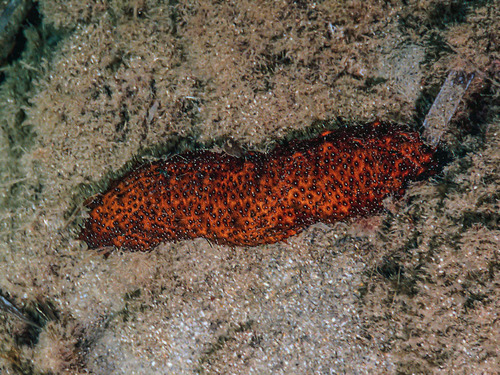
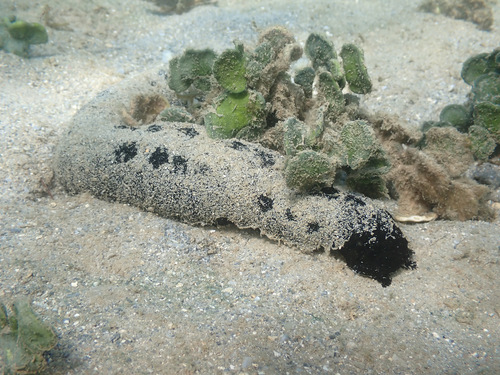
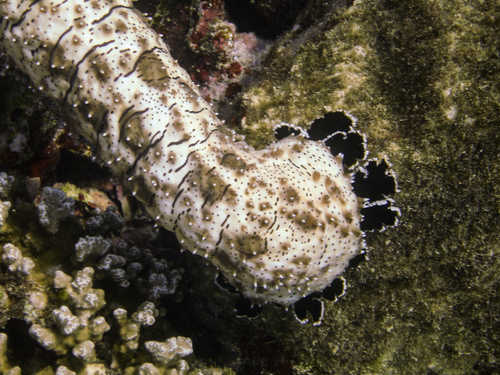
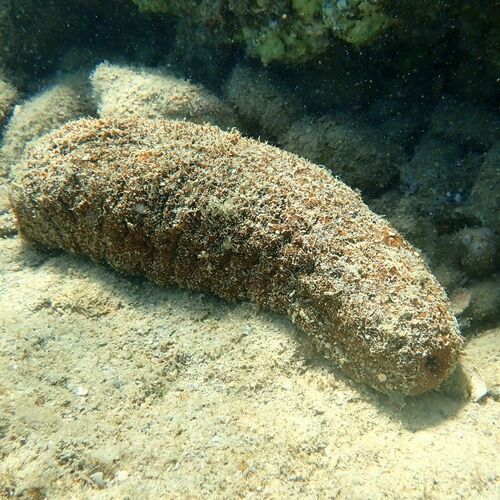
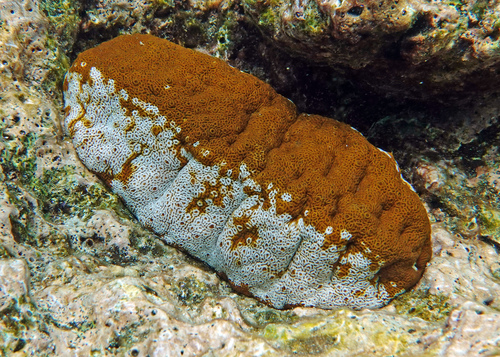
Actinopyga mauritiana (Quoy & Gaimard, 1834) typically reaches a length of 220 to 350 mm (9 to 14 in), with a maximum width of 10 cm (4 in). Its body is wider at the middle and tapers toward both ends. The body wall is rough, leathery, and has a maximum thickness of 6 mm. The bivium (dorsal surface) is dark brown or orange, sometimes marked with occasional white spots, and may be wrinkled. It is covered in long, slender papillae that are usually dark orange or brown. The trivium (ventral surface) is white, and covered in many stout podia. The anus is surrounded by twenty-five anal teeth. Unlike most other sea cucumbers, this species never expels its pinkish Cuvierian tubules. This species occurs in the tropical Indian Ocean and western Pacific Ocean, off the coasts of Asia and Africa. Its range extends from the Red Sea in the west to Hawaii in the east. It is especially common off the coast of Madagascar, where it occurs along the west coast from southern Toliara to Nosy Be. It inhabits outer reef flats and fringe reefs at depths between 0 and 50 m (0 to 160 ft). It is more active during the day, when it feeds on substrate. Actinopyga mauritiana is commercially harvested for food across its entire range. It is processed to make bêche-de-mer, a delicacy that is consumed, and becomes more important as a food source during periods of hardship. It is harvested by 22 countries and island states in the Western Central Pacific, and is one of the top three species used for local subsistence.