About Actinopyga echinites (Jaeger, 1833)
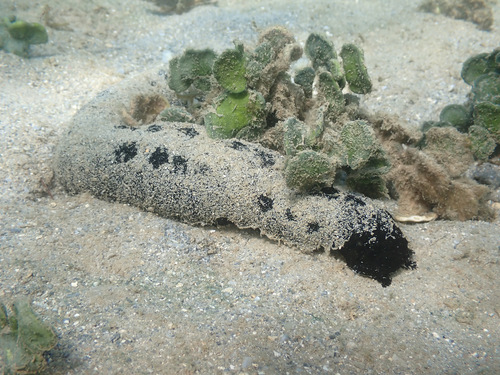
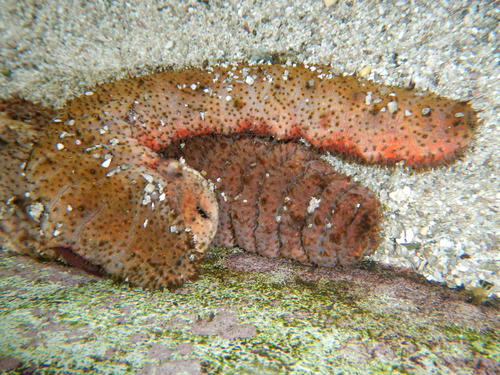
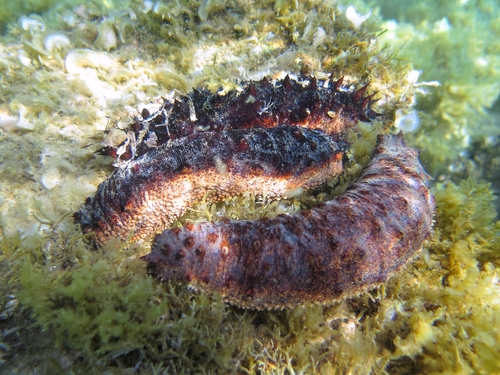
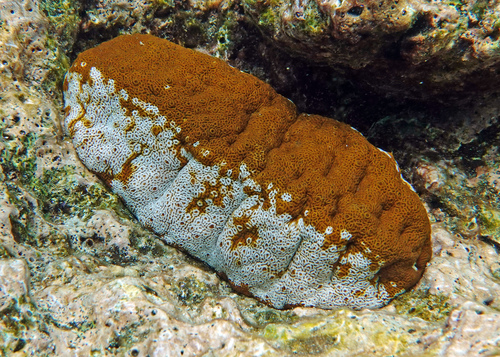
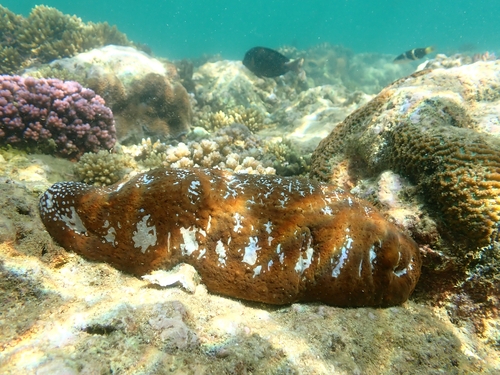
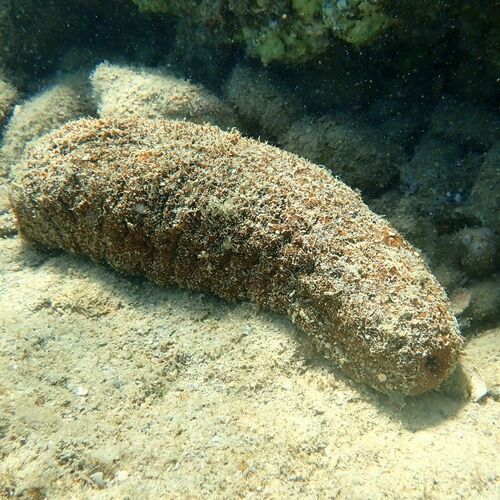
Actinopyga echinites (Jaeger, 1833) reaches a length of approximately 300 to 350 mm (12 to 14 inches). Its body is widest at the middle, tapering slightly toward both ends, with an arched dorsal surface and a flattened ventral surface. Its rough, leathery skin is covered in papillae, and is strengthened by microscopic spike-like structures called spicules, which are shaped like large rods in this species. This sea cucumber is brown on its upper surface and orange-brown on its lower surface, and sand often adheres to its upper body. The anus is surrounded by five beige anal teeth, and pinkish Cuvierian tubules are occasionally discharged through the anus when the animal is stressed. This species occurs off the coasts of Asia and Africa, in the tropical Indian Ocean and the western Pacific Ocean. Its range extends from the Red Sea, the east coast of Africa, and Madagascar, to Indonesia, northern Australia, the Philippines, New Guinea, and other island groups in the western Pacific. It lives on the seabed in shallow water, occurring on reef flats, fringing flats, in lagoons, and in estuaries, at depths between 0 and 30 m (0 and 100 ft). It is often abundant in seagrass meadows and on rubble areas.