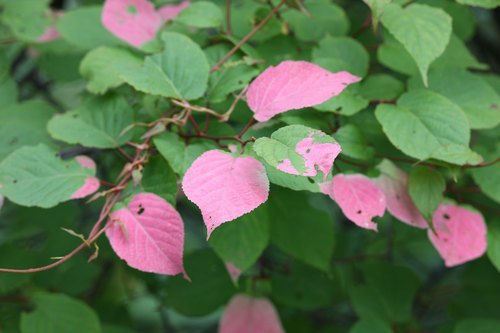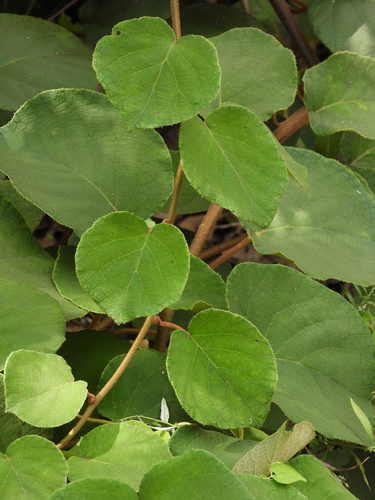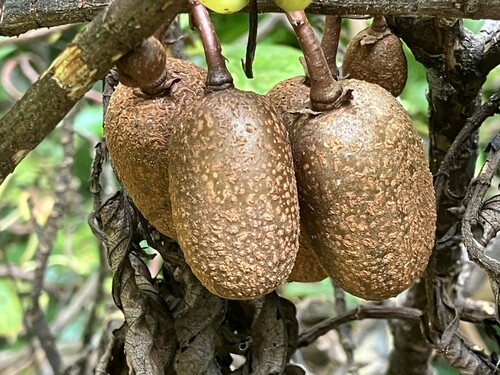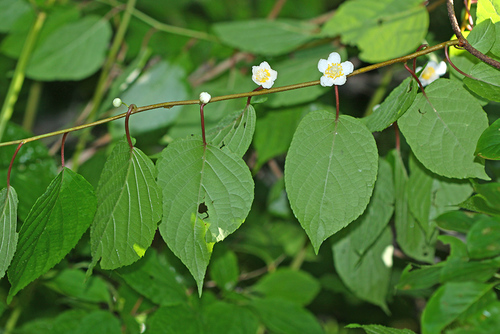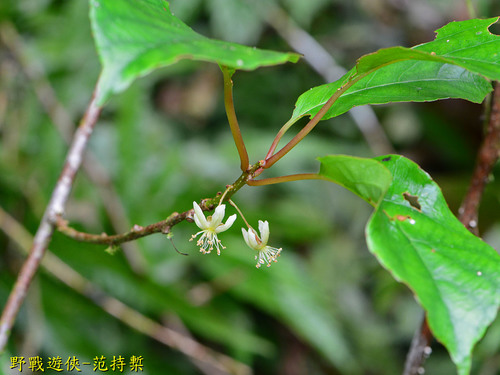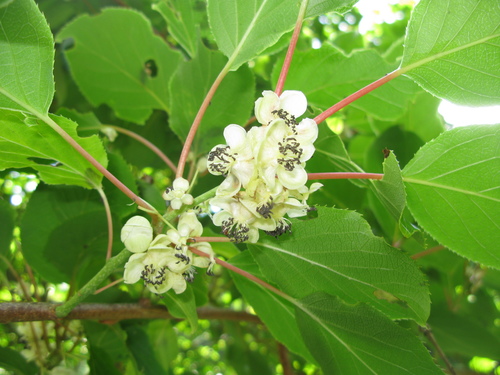
About Actinidia arguta (Siebold & Zucc.) Planch. ex Miq.
Actinidia arguta (Siebold & Zucc.) Planch. ex Miq. produces an edible fruit that has many common names: kiwiberry, arctic kiwi, baby kiwi, cocktail kiwi, dessert kiwi, grape kiwi, hardy kiwifruit, northern kiwi, Siberian gooseberry, or Siberian kiwi. The name "kiwiberry" grew in popularity through the 2010s and 2020s. This fruit is berry- or grape-sized, with a taste and appearance similar to common kiwifruit. Its skin can be green, brownish, or purple, is smooth, and sometimes has a red blush. It is often sweeter and more sharply flavored than common kiwifruit, and can be eaten whole without peeling. Its thin-walled exterior is smooth and leathery. Actinidia arguta has one of the widest native ranges of any species in the genus Actinidia, found across China, eastern Russia, Korea, Taiwan and Japan. Compared to most other Actinidia species, it grows in much colder areas, typically at altitudes between 150 and 1,500 m (490 to 4,920 ft) above sea level. It grows in locations including the Yan Mountains and the northeastern Chinese provinces of Jilin and Liaoning. In southern Japan, the plant can grow at altitudes up to 1,900 m (6,200 ft), and has been recorded growing at altitudes as high as 3,000 m (9,800 ft). The most wild records of Actinidia arguta come from central China, northeastern China, the Korean peninsula and Japan. This species grows in both mountainous and forested areas, and can survive winter temperatures as low as −45 °C (−49 °F), as well as summer temperatures above 37 °C (99 °F). Macrofossils of A. arguta dating to the early Pliocene epoch have been found in western Georgia in the Caucasus region. For A. arguta vines to produce fruit, both male and female plants must be present to allow pollination; one male pollinator can enable fruit production on six female plants. Flowering typically occurs in late spring (May in the Northern Hemisphere), starting in the plant's third year of growth. If flowers become damaged by frost, no fruit will be produced for the rest of that year. Harvest takes place in autumn for all varieties, and the exact harvest time depends heavily on the local climate and the specific cultivar grown. A single female vine can produce up to 100 pounds of fruit per year, with an average annual yield of roughly 50 pounds per vine. Both fruit size and total yield vary greatly by cultivar. Fruit left to ripen on the vine has an 18 to 25% sugar content at harvest. Actinidia arguta was first cultivated in Europe and North America in the late 19th century as an ornamental plant. Some of the earliest seeds for European plantings were collected from Hokkaido, Japan, by William S. Clark in 1876. The first commercial kiwiberry plantings were established in Oregon, United States in the late 1990s. Small commercial plantings were later established in New Zealand, Chile, Italy, France, and Switzerland. Historical attempts to commercialize the fruit have been unsuccessful due to its short shelf life and irregular ripening. However, there are ongoing efforts to expand commercial production, and small-scale commercial production initiatives are underway in South America, New Zealand, Europe, Canada, and the United States (in Oregon, Washington, and central Pennsylvania). South Korea's National Institute of Forest Science develops and distributes new hardy kiwi cultivars as a high-value crop. The relatively low height of cultivated plants makes maintenance easier, which is seen as an advantage for commercial cultivation. In 2015, the total global area under kiwiberry cultivation was estimated at 1,640 ha (4,100 acres), with 1,260 ha (3,100 acres) of that located in China. Between 2015 and 2019, an additional 2,300 ha (5,700 acres) of kiwiberry plantations were established in China. As of 2023, South Korea produced 45.4 t (44.7 long tons; 50.0 short tons) of kiwiberries, with approximately 30 t (30 long tons; 33 short tons) of that total coming from Gangwon Province. Actinidia arguta is a fast-growing, climbing, twining hardy vine, which gives it the common name hardy kiwi. It is capable of surviving slow temperature drops to −45 °C (−49 °F), and can tolerate summer temperatures exceeding 37 °C (99 °F), though young spring shoots can be vulnerable to frost damage. The vines require a frost-free growing season of about 150 days, but are not damaged by late freezes if temperature changes are gradual enough to let the plants acclimate. A period of winter chill is required for successful cultivation, but the vines can also be grown in low-chill areas. Rapid freezes will kill buds and split vines. Hardy kiwi can be grown directly from seeds, which have a germination time of about one month, but also can be propagated from cuttings. Growing from seeds requires one to two months of cold stratification for germination. Hardy kiwi cuttings may be grafted directly onto established common kiwifruit rootstock, or rooted on their own. In home cultivation, a trellis is often used to encourage horizontal growth that makes maintenance and harvesting easier. Vines grow extremely quickly and require a strong trellis for support; under ideal conditions, each vine can grow up to 20 ft (6.1 m) in a single season. For commercial planting, site placement is important: plants can tolerate partial shade, but maximum yields require full sunlight. Hardy kiwi vines need large amounts of water, so they are usually grown in well-drained, acidic soils to prevent root rot. Kiwiberries are primarily grown for the fresh fruit market, and are sold in small punnets as a ready-to-eat product. They are also processed into jams, preserved fruit and juices. In China, commercial kiwiberry food products include nutritional powder additives and fruit vinegar, and kiwiberry wine is produced in the United States. In Korea, this species is known as darae (다래). Young leaves, called darae-sun, are commonly eaten as a namul vegetable. Vines can be tapped in early spring to collect sap. Migratory farmers in Gangwon province are reported to have used this sap as a food source during times of famine.