About Actinia fragacea Tugwell, 1856
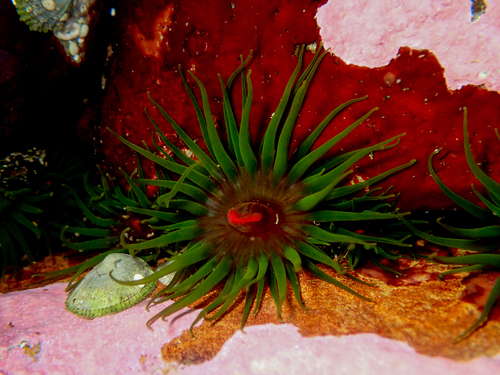
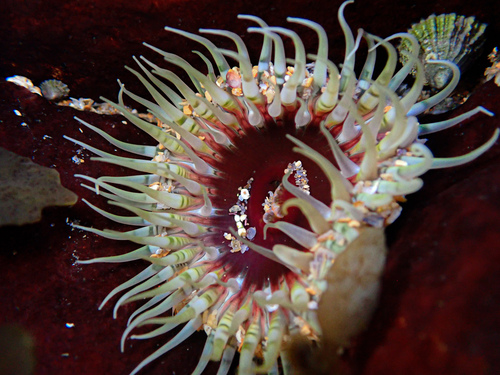
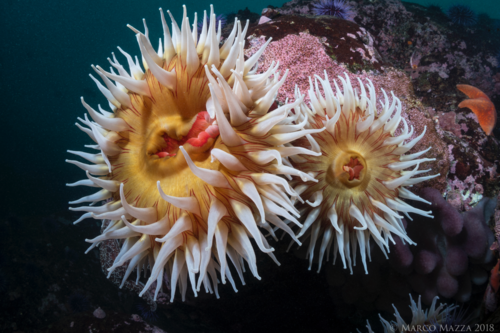
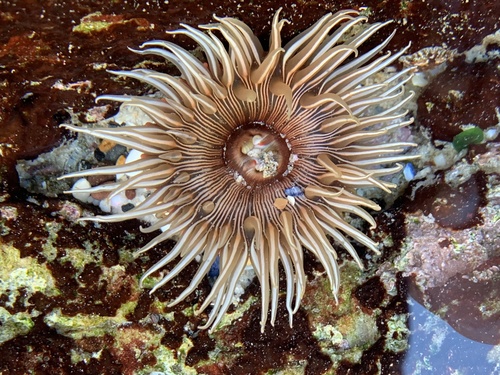
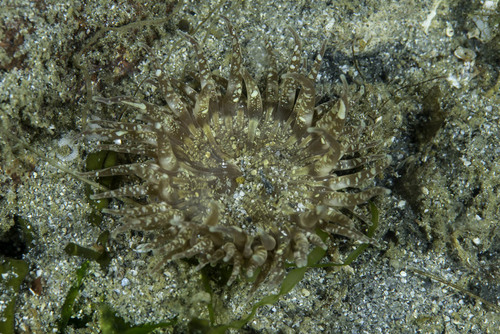
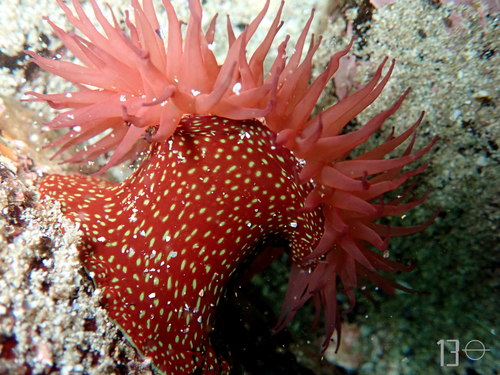
This species, commonly called the strawberry anemone, has the scientific name Actinia fragacea Tugwell, 1856. It has a smooth column that is typically red or dark red, marked with many greenish spots. Its tentacles are usually red or purplish. Actinia fragacea is similar in shape to the beadlet anemone (Actinia equina), and was once classified as a variant of that species. However, it is typically larger, growing up to 100 millimetres (3.9 in) across its base. It also has a distinct, visible ring of pale blue, red, pink, or white spots called "acrorhagi" around the inside of the top of its column. The strawberry anemone is distributed across the northeastern and eastern Atlantic Ocean. Its range stretches from Norway, England, Scotland, and Ireland down to the Mediterranean Sea and North Africa, and includes the Azores, the Canary Islands, and Cape Verde. It lives on the lower shore and in the sublittoral zone, at depths generally less than 10 metres (33 ft). It most often attaches to rocks and boulders, but is sometimes found semi-immersed in sand. Note that several other marine species share the common name "strawberry anemone": the Californian species Corynactis californica, the southern African species Corynactis annulata, and Urticina lofotensis, which occurs in the North Atlantic Ocean and along the Pacific coast of North America. Little is known about the reproduction of Actinia fragacea. It has separate sexes, uses an oviparous reproductive system, and does not appear to brood its young. A well-known early studied individual of beadlet sea anemone, possibly actually a strawberry anemone, was the specimen nicknamed "Granny". It was found on Scotland's east coast by John Dalyell in 1828, and Dalyell published a detailed early study of its behaviour.