About Actinia equina (Linnaeus, 1758)
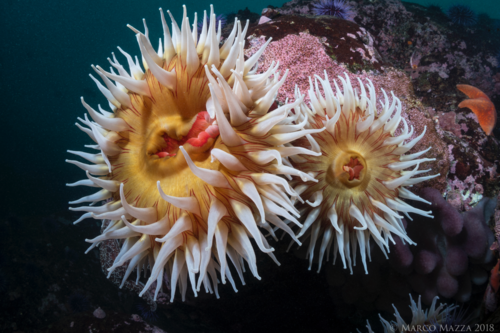
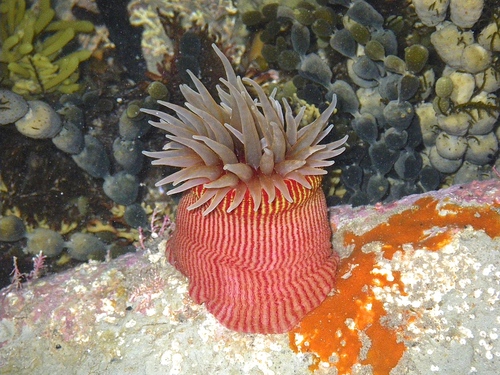
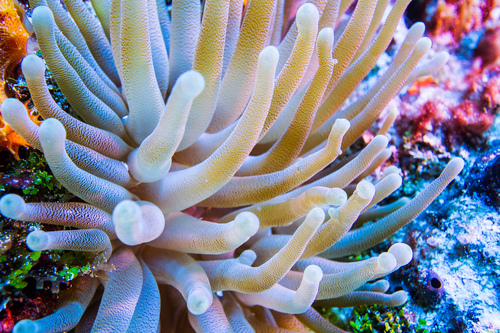
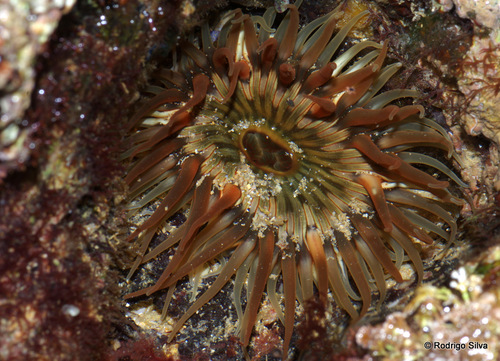
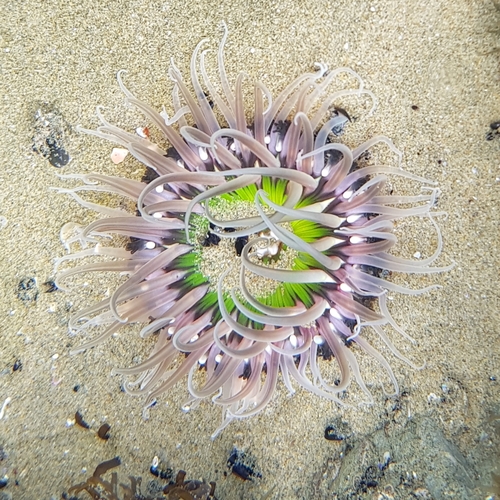
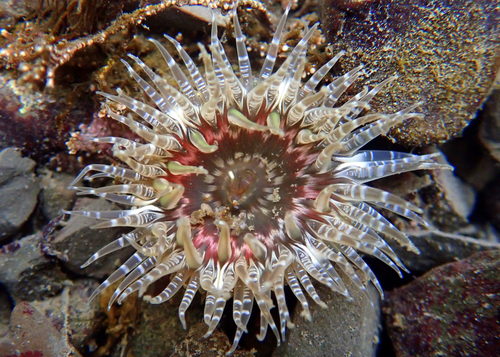
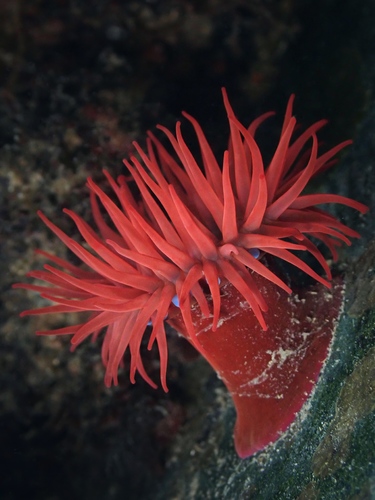
The beadlet anemone, Actinia equina, is a common sea anemone. It occurs on rocky shores along all coasts of Western Europe, the Mediterranean Sea, the Atlantic coast of Africa extending south to South Africa, Australia, and the coasts of East Asia. This species can live in both exposed and sheltered environments. It is highly adapted to the intertidal zone, as it tolerates both high temperatures and desiccation. It may also be found in areas with variable salinity, such as estuaries. Beadlet anemones can live either solitarily or in aggregations. Solitary individuals grow to a larger size than those living in clustered groups. Larger beadlet anemones are typically found submerged at low tide, where they have greater access to food resources and experience less exposure to harsh environmental conditions. The size of these anemones may be linked to their physiological adaptations to limited food and challenging environmental conditions. When underwater, Actinia equina displays up to 192 tentacles arranged in six circles. When out of water, its tentacles retract, and the anemone takes the form of a red, brown, green, or orange jelly-like blob, reaching up to around 5 centimetres (2.0 in) across. Just beneath its tentacles, it has bright blue bead-like structures called acrorhagi, arranged in an external ring at the top of the anemone's column. These structures hold stinging cells, which the anemone uses to fight over territory. The acrorhagi contain cnidocysts, which in turn hold nematocysts. There is some evidence that the different color forms of this species may actually be separate distinct species. Actinia equina is similar in form to the Waratah anemone, Actinia tenebrosa, native to Australia and New Zealand. It is also similar in form to the strawberry anemone, Actinia fragacea, but it is a uniform color and is typically smaller. Actinia equina is viviparous: up to one hundred embryos develop inside the anemone's body cavity before juveniles are ejected into open water. A well-documented individual called "Granny" was found on Scotland's east coast by John Dalyell in 1828; it produced several hundred offspring before it died in 1887. The only recorded predator of the beadlet anemone is the grey sea slug.