About Actinemys marmorata (Baird & Girard, 1852)
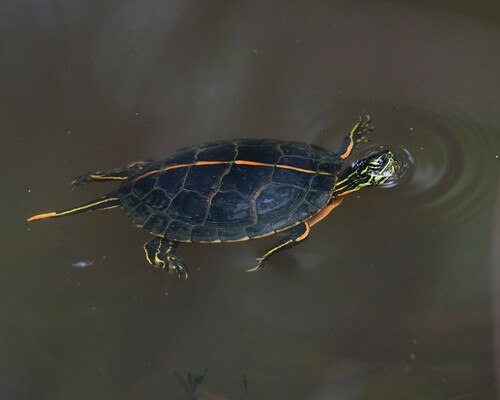
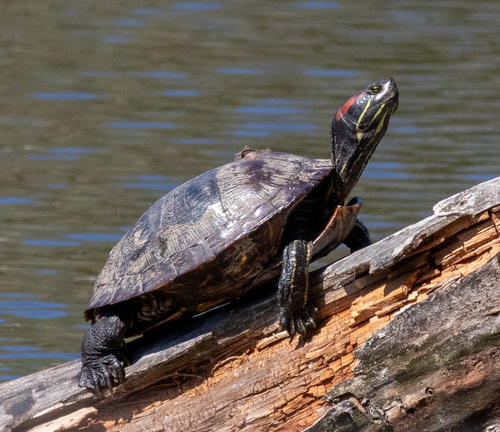
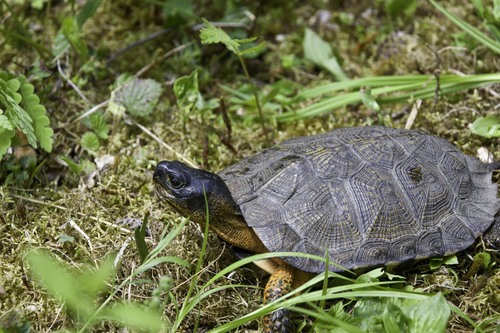
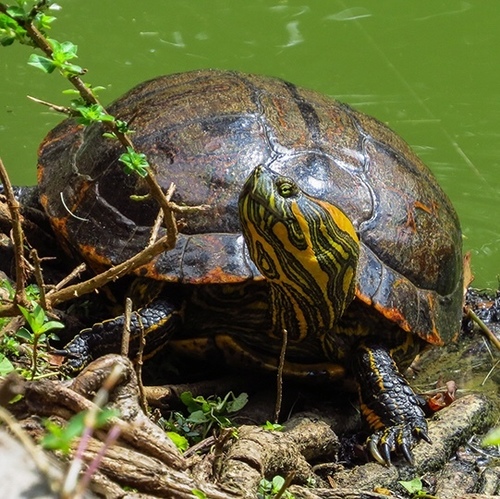
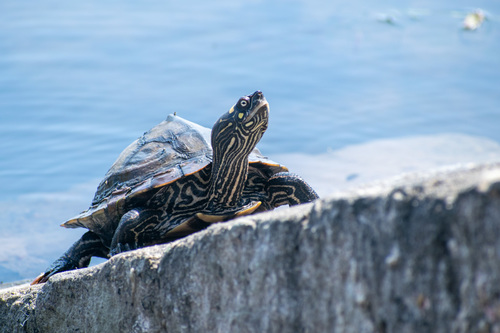
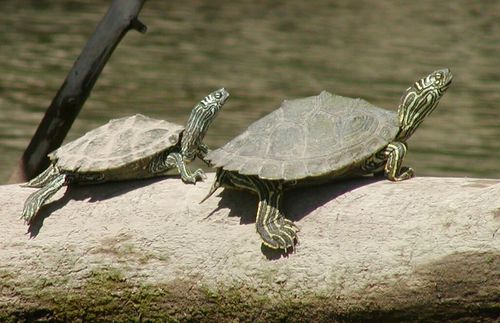
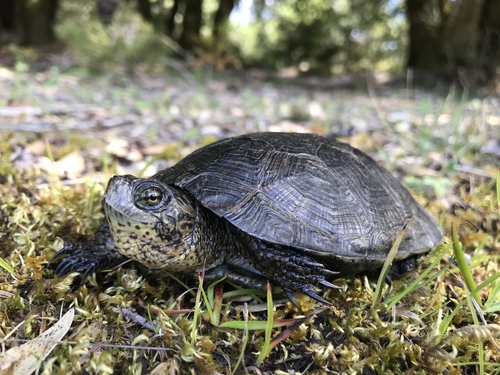
Actinemys marmorata, commonly known as the northwestern pond turtle (previously classified together with the southwestern pond turtle Actinemys pallida as the single western pond turtle species), has a distinct physical description. Its dorsal surface is usually dark brown or dull olive, and may or may not have darker reticulations or streaking. The plastron is yellowish, and sometimes has dark blotches at the center of each scute. Adult straight carapace length ranges from 11–21 cm (4.5–8.5 in). The carapace is low and broad, usually widest behind the middle; adult carapaces are smooth, with no keel or serrations. Adult western pond turtles are sexually dimorphic: males have a light or pale yellow throat. This turtle originally ranged from northern Baja California, Mexico, north to southern British Columbia, Canada. Historically, it was a major part of a fishery on Tulare Lake, California, where it supplied turtle soup, a popular local food, to San Francisco, and was used as feed for hogs that learned to dive for the turtles in the shallows of Hog Island on Tulare Lake. As of 2007, the species has become rare or entirely absent from the Puget Sound region of Washington. It has a disjunct distribution across most of the Northwest, and a small number of isolated populations remain in southern Washington. It is now rare in the Willamette Valley north of Eugene, Oregon, but becomes more abundant south of Eugene where temperatures are higher, and may be locally common in some streams, rivers, and ponds of southern Oregon. There are a few records of the species east of the Cascade Mountains, but these are thought to refer to introduced individuals. Its elevation range goes up to 305 m (1,001 ft) in Washington, and to about 915 m (3,002 ft) in Oregon. It also occurs in the Uvas Canyon area of the Santa Cruz Mountains, California, the California North Bay, and in lakes such as Fountaingrove Lake. Many taxonomic authorities have split what was once considered a single western pond turtle species into two: the southern Actinemys pallida (southwestern pond turtle), found in southern California and Mexico, and the northern Actinemys marmorata (northwestern pond turtle) ranging from northern California northward. Actinemys marmorata lives in both permanent and intermittent bodies of water, including marshes, streams, rivers, ponds, and lakes. It prefers habitats with abundant emergent logs or boulders, where individuals gather to bask; they also bask on top of aquatic vegetation, which means the species is often overlooked in the wild. Slow movement and hiding behind trees and shrubs can allow observers to spot resident turtles. A. marmorata can be encouraged to use artificial basking substrates, or rafts, which makes it easy to detect the species in complex habitats. Terrestrial habitat is extremely important for this species: many intermittent ponds dry out during the summer and fall along the west coast, especially during drought, so A. marmorata can spend more than 200 days out of water. Many individuals overwinter on land, and often create their annual nests during this overwintering period. Overwintering sites can sometimes be located 500 meters from the nearest main body of water. Sexually mature female northwestern pond turtles lay 5–13 eggs per clutch, and can deposit clutches once or twice a year. Females may travel a significant distance from water to lay eggs, moving as far as 0.8 km (1/2 mile) away from the nearest water source and up to 90 m (300 ft) above it, though most nests are located within 90 m (300 ft) of water. Females usually leave the water in the evening and may wander a long distance before choosing a nest site, which is typically an open, south-facing area of sand or hardpan. The nest is flask-shaped, with an opening around 5 cm (2 in) across. Females spend a lot of time covering the nest with soil and nearby low vegetation, making the nest very hard for people to find unless it has already been disturbed by a predator.