About Actias truncatipennis Sonthonnax, 1899
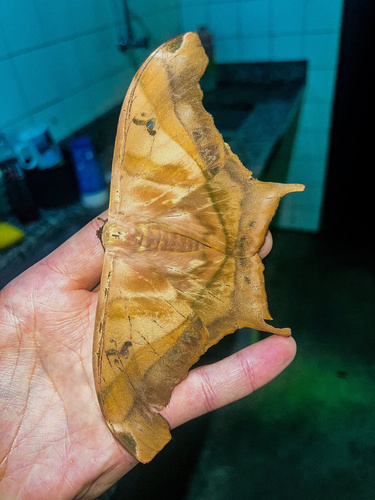
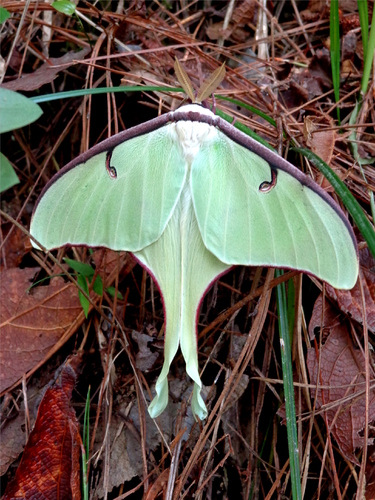
Actias truncatipennis, commonly called the Mexican Moon Moth, is an uncommon moth in the family Saturniidae. It may be the only species of the genus Actias native to Mexico. This species was first formally described by Léon Sonthonnax in 1899. It resembles the related Luna moth, but is noticeably larger, and the lower edge of its forewings is more curved. Its larvae look almost identical to those of A. luna, and are thought to also be larger. Like A. luna, this species has seasonal forms that differ slightly in appearance, which indicates it produces multiple generations each year. These seasonal differences appear in the presence or absence of distinct red-brown wing edges, and in the length and slenderness of wing tails; the form with colored wing edges is thought to be the spring form. In the wild, both larvae and adults can be found from March through October. The species overwinters in diapause in the pupal stage. Larval development is split into 5 instars, meaning larvae shed their skins 4 times after hatching from the egg, not counting the hatching molt. Larval development can progress surprisingly quickly; some reared individuals reached the cocoon-spinning stage in only 18 days after hatching, though these reared individuals wound up smaller in size. This faster development was likely caused by exposure to extreme heat. Cocoons typically take around 27 days to produce hatching adults. This moth's habitat is concentrated at higher elevations in cloud forest regions of southeastern Mexico, covering the Mexican states of Hidalgo, Puebla, Veracruz, Querétaro, San Luis Potosí, Tlaxcala, and Estado de México, and possibly also parts of Morelos and northern Oaxaca. Its wild population currently appears fairly stable, but its range is gradually threatened by logging. Like A. luna, A. truncatipennis can hybridize with other species in the genus Actias, and even with species in the genus Graellsia. This ability to hybridize is linked to shared evolutionary history on the American continent, after the group migrated to the Americas via the Bering Ice Bridge.