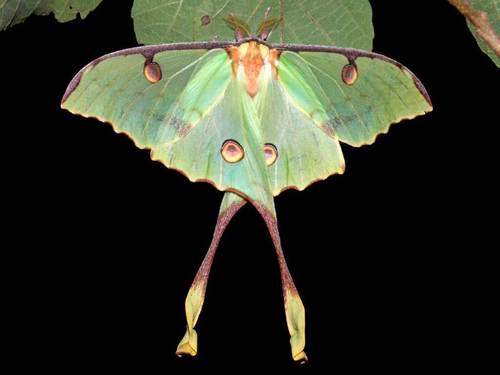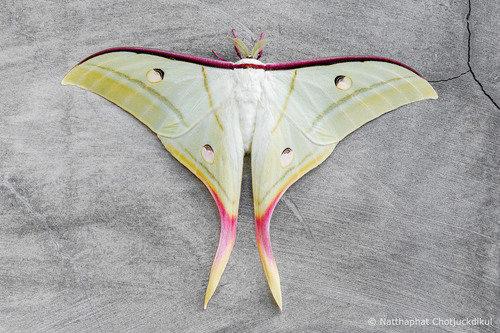
About Actias selene Hübner, 1806
Actias selene, commonly known as the Indian moon moth or Indian luna moth, is a species of saturniid moth native to Asia. Its accepted scientific name is Actias selene Hübner, 1806, though it has been noted that this species was first described by Jacob Hübner in 1807. It is popular among amateur entomologists, and is often reared from commercially available eggs or cocoons. Adults of this species fly mainly at night.
This moth is very widespread across Asia. It can be found from India east to Japan, and south into Nepal, Sri Lanka, Borneo, and other islands in eastern Asia. Numerous subspecies occur in Pakistan, Afghanistan, the Philippines, Russia, China, Java, Sri Lanka, Sumatra, and Borneo.
The eggs of Actias selene measure about 2 mm (0.079 in), are white in base color, and covered with extensive black and brown mottling. Egg incubation lasts approximately 12 days. Newly hatched larvae are red, with a black saddle-shaped marking on the abdomen. Second-instar larvae are entirely red, with black heads. Larvae do not develop a green body color until they reach the third instar. Developing larvae require prefer humid environmental conditions.