About Actias maenas Doubleday, 1847
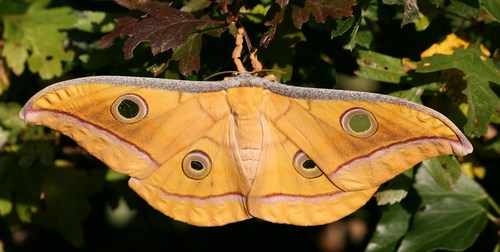
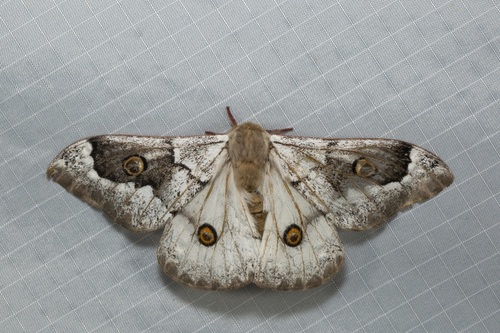
Actias maenas Doubleday, 1847, commonly called the Malaysian moon moth, is a Saturniid moth that belongs to the subfamily Saturniinae and is native to Indomalaya. Males of this species have purplish-brown and yellow coloration, while larger females are overall light green. The range of the Malaysian moon moth extends from Malaysia through Sumatra, Java, the Philippines, and the surrounding Southeast Asian region. A population previously associated with this species found in the Western Ghats was described as the new separate species Actias keralensis in 2020. The species occupies a diverse range of biomes, from tropical rainforests to evergreen forests. First instar larvae are orange, with a black band wrapping around their middle segments and a black head capsule. After the first moult, second instar larvae are green with yellow or orange tubercles, a brown head capsule, and black markings behind the head, on the rear claspers, and on the anal flap. By the third instar, the dark markings behind the head capsule become less prominent, and larvae develop a fine pattern of white dots across their skin. Larvae rest holding the anterior end of their body away from the substrate, such as a leaf or stem. Males complete development a few days earlier than females in both larval and pupal stages, because they are smaller. Pupae are dark brown, with a transparent window area between the compound eye covers. Cocoons have an irregular shape and a papery texture. They are light brown with a glossy sheen, and have a pre-formed exit opening at the anterior end. Adult moths can easily push their way out of these flimsy cocoons. Wing expansion is finished 45 minutes after emergence. Tail expansion begins once the forewings have fully expanded. Females fly only after their wings have hardened. After their first flight, females emit pheromones and mate.