About Actias luna Linnaeus, 1758
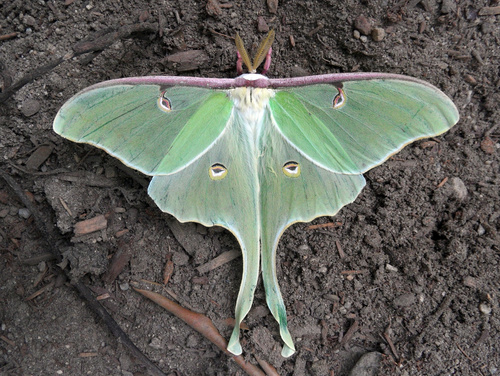
Actias luna Linnaeus, 1758, commonly called the Luna moth, has the following life stages, physical traits, distribution, and life cycle patterns. Eggs are laid in small groups attached to the undersides of leaves. They are mottled white and brown, slightly oval, and roughly 1.5 millimeters in diameter. Larvae are primarily green and covered in sparse hairs. After hatching from the egg, the first instar reaches 6–8 mm (0.24–0.31 in) in length; the second instar reaches 9–10 mm (0.35–0.39 in); the third reaches 12–16 mm (0.47–0.63 in); and the fourth reaches 23–26 mm (0.91–1.02 in). The fifth and final instar grows to approximately 70–90 mm (2.8–3.5 in) in length. Small yellow or magenta colored dots may line the sides of fourth and fifth instar larvae. Right before they begin cocooning, larvae may turn reddish-brown. Fifth-instar larvae move down to the ground, where they use silk to bind dead leaves around their cocoon. When adult sexually mature, winged moths called imagoes emerge from pupae, their wings are small, crumpled, and held close to the body. The wings enlarge to their full full size over the course of several hours. The typical wingspan of adult Luna moths is 8–11.5 cm (3.1–4.5 in), and rare individuals can reach a wingspan of 17.78 cm (7.00 in). Females and males are similar in both size and appearance. They have green wings, with eyespots on both their forewings and hind wings, and long, sometimes slightly twisted tails that extend from the back edge of the hindwings. Their bodies are white and hairy. Adults have vestigial mouthparts and do not feed; they rely on fat stores built up when they were caterpillars for energy. The forward edge of the forewing is dark-colored and thick, tapering in thickness from the thorax toward the wing tip, and its color ranges from maroon to brown. Each wing holds one eyespot: forewing eyespots are oval in shape, while hindwing eyespots are round. Each eyespot can have arcs of black, blue, red, yellow, green, or white, and the eyespots are thought to confuse potential predators. There are small appearance differences linked to sex and region. Females have a larger abdomen than males, as it holds 200–400 eggs. Both sexes have antennae, but male antennae are much longer and wider. Individuals from northern populations, and overwintering generations in central and southern U.S. states, have blue-green wing color; second and third generations in these regions have a more yellow-green wing tint. The Luna moth is distributed across North America. It is found east of the Great Plains in the United States, ranging from Florida to Maine, and ranges from Saskatchewan eastward through central Quebec to Nova Scotia in Canada. Rare vagrant individuals are also occasionally found in Western Europe. The number of generations Luna moths produce per year depends on the climate of their habitat. In Canada and the northern regions of the United States, the species is univoltine, meaning it produces one generation per year. In this region, the life stage timings are roughly: 10 days as eggs, 6–7 weeks as larvae, 2–3 weeks as pupae, and one week as winged adults that emerge in late May or early June. In the mid-Atlantic U.S. states, the species is bivoltine, producing two generations per year. Further south, the species is trivoltine, producing three generations per year. In central U.S. states, the first generation of adults appears in April, and the second appears in July. In even further southern areas, the first generation can appear as early as March, with the second and third generations appearing eight to ten weeks after the previous one.