About Acrotriche serrulata (Labill.) R.Br.
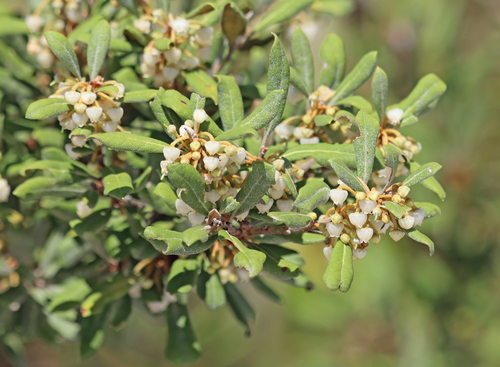
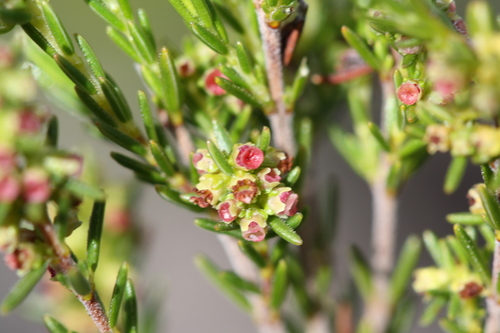
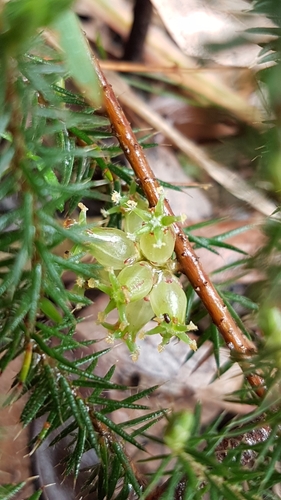
Acrotriche serrulata (Labill.) R.Br., commonly called honey pots, is a low-lying, mat-forming shrub. It typically spreads to around 1 metre (3 feet 3 inches) wide, and has ascending branches that reach 15 to 60 centimetres (5.9 to 23.6 inches) in height. Its leaves are lance-shaped to linear, measuring 3.5 to 13.0 millimetres (0.14 to 0.51 inches) long and 0.5 to 2.0 millimetres (0.020 to 0.079 inches) wide, borne on a petiole 0.3 to 0.7 millimetres (0.012 to 0.028 inches) long. The leaves have finely toothed margins and shallow grooves on their lower surface. Flowers are arranged in spikes of 5 to 10, with 1.0 to 1.5 millimetre (0.039 to 0.059 inch) long bracteoles at the base of each spike. The sepals are 1.4 to 2.8 millimetres (0.055 to 0.110 inches) long. The petals are pale green or whitish, joined at the base to form a tube 4.0 to 4.7 millimetres (0.16 to 0.19 inches) long, with lobes 1.5 to 2.0 millimetres (0.059 to 0.079 inches) long. Flowering takes place from August to September. The fruit is a flattened spherical capsule 2.5 to 4.5 millimetres (0.098 to 0.177 inches) long, and is greyish-green. This species is widely distributed in New South Wales, the Australian Capital Territory, Victoria and Tasmania. It grows in woodland, forest, coastal heath and mallee shrubland.