About Acrothamnus colensoi (Hook.fil.) Quinn
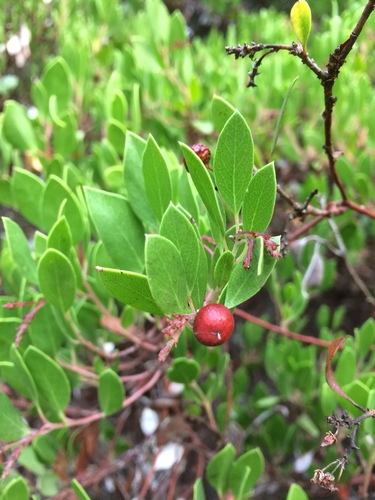
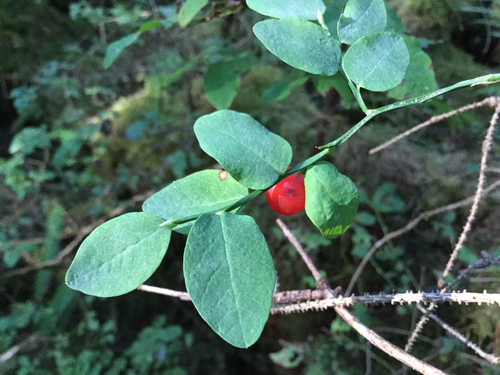
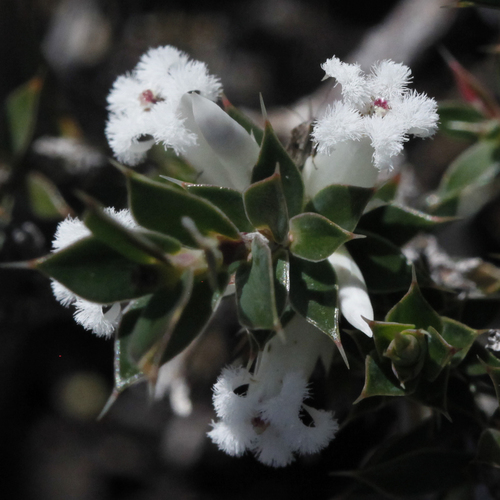
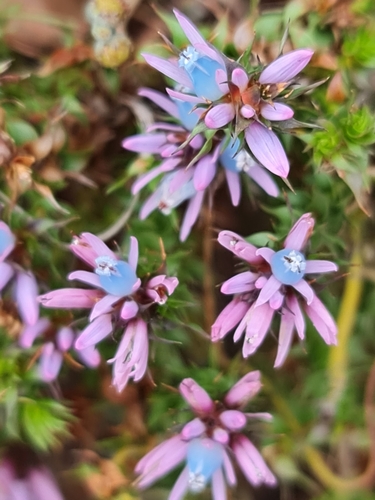
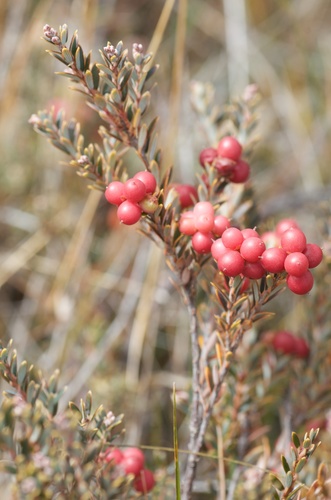
Acrothamnus colensoi is a sprawling, branched low-growing or prostrate shrub. It usually reaches 40 cm in height and 60 cm across, but can sometimes form patches up to 2 m across. Its branches are ascending to erect, weakly ribbed, and grey-brown in colour. Leaves are alternate and spreading, 5–10 mm long by 1–4 mm wide. They are sessile or subsessile, lozenge-shaped (oblong, narrowing to a fine point), and pinkish green to red-brown. They have 3–5 prominent parallel greenish veins, white interveinal grooves, and may have a white stripe on the underside. When young, leaf margins are distinctively finely hairy; mature leaves are mostly glabrous, and margins are rolled downwards and inwards. This species produces honey-scented white to yellowish flowers, borne in clusters of 2–5 at branch tips. Flowers are 6–8 mm long, with a 4–5 mm corolla tube that is hairy in its upper section. Each flower is subtended by one bract up to 2.5 mm long, which is pinkish green to red, glaucescent, broadly ovate, obtuse, and ciliolate, plus two smaller, very similar keeled bracteoles. Sepals are up to 4 mm long, imbricate, and have stomata only on the adaxial surface. Flowers have both male and female reproductive parts, but often function as only male or female; functionally female flowers can produce fruit. Fruit are globose, fleshy, glossy berries 4–5 mm in diameter, ranging in colour from white, pink, and red, through crimson to almost black. The thin berry flesh surrounds 5 hard seeds. The chromosome number of A. colensoi is 2n = 146, which is distinctive and not seen in other members of the ericoid tribe Styphelieae in New Zealand.
This species is endemic to New Zealand, found on both main islands, ranging from the central North Island to Otago. In the South Island, it occurs in the drier eastern mountains of Marlborough and Canterbury, is present locally in Otago, and is rare in northern Southland. It grows mostly in montane to low-alpine habitats between 600 and 1600 m elevation, and extends to lower altitudes in the southern part of its range. It prefers well-drained sites in shrubland, tussock grassland, and on rocky outcrops.
A. colensoi flowers from September to February, and fruits from November to June. Its fleshy berries are eaten by birds, reptiles, and invertebrates, though they are hardly palatable to humans. Its leaves and flowers are very rarely eaten by animals.