About Acropternis orthonyx (Lafresnaye, 1843)
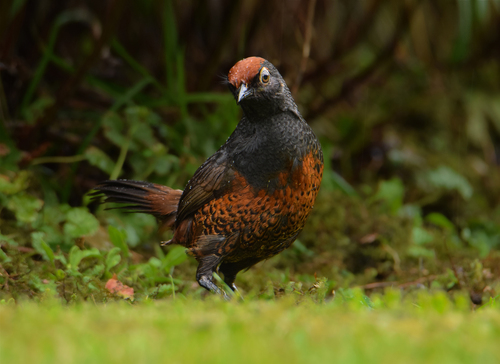
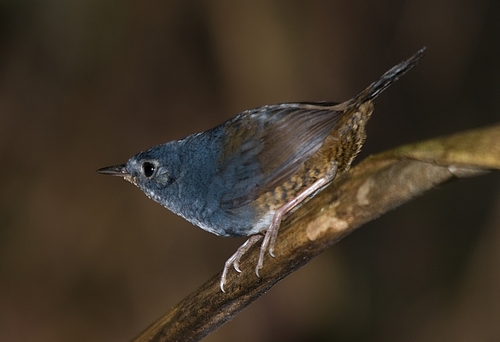
This species is a passerine bird commonly known as the ocellated tapaculo, with the scientific name Acropternis orthonyx (Lafresnaye, 1843). On average, this bird measures 8.3–8.7 inches (21–22 cm) in length and weighs between 2.8–3.5 ounces (80–100 grams). Its plumage is mostly black with large white spots, it has brown flanks, and its head and throat are reddish in color. Individuals produce a loud, emphatic "WHEEUW!" whistle call that is audible over long distances; this call is thought to be used to announce the bird’s presence to other members of its own species. It is typically found alone or in pairs, hopping through bamboo growth along the forest floor. It prefers to stay close to the ground, so it is more often heard than seen. Researchers and birdwatchers can attract this species by playing recorded calls or imitating its call, and ocellated tapaculos will approach from distances of several kilometers to investigate. This species is sometimes split into two subspecies. The subspecies Acropternis orthonyx infuscatus occurs in the mountains of Ecuador and northern Peru. The nominate subspecies A. o. orthonyx ranges farther north, from the Cordillera Central and Cordillera Oriental of Colombia to the mountains of northwestern Venezuela. Small populations of the nominate subspecies are also present in the Cordillera Occidental, at minimum in Antioquia and Páramo de Frontino. It is not usually found on the Amazonian slope of the East Colombian and Venezuelan mountains it inhabits. On the Cordillera Oriental, the species is only known from a small number of locations between 8,200 and 10,000 feet (2,500–3,000 m) above sea level. Northern and southern populations of this species are barely distinguishable from one another, so many authors do not recognize any separate subspecies. This bird favors humid, low-growing forest where the tree canopy reaches around 50–80 feet (15–25 m) in height. Common dominant tree species in its preferred habitat can include Brunellia, Hieronyma rufa (in the family Phyllanthaceae), Ocotea calophylla (in the family Lauraceae), oaks (Quercus), glorytrees (Tibouchina), and Weinmannia. These forests are typically heavily overgrown with epiphytes. The most critical habitat feature for this species is a tangled understory that contains abundant stands of South American mountain bamboo (Chusquea). This bamboo forms impenetrable thickets alongside other plants like the palm Geonoma weberbaueri and Ericaceae shrubs. Because this species depends on bamboo thickets that only grow in clearings, it tolerates selective logging well, and may even benefit from this logging activity.