About Acropora prolifera (Lamarck, 1816)
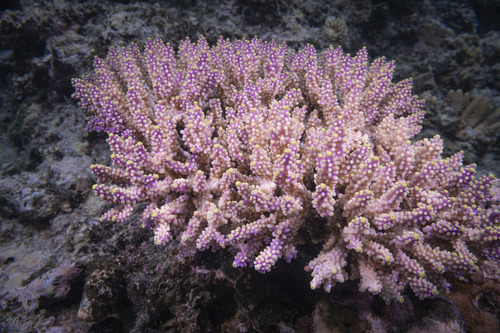
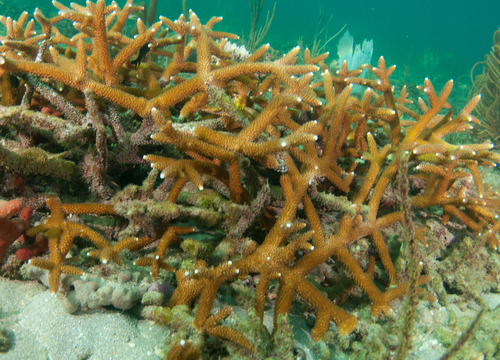
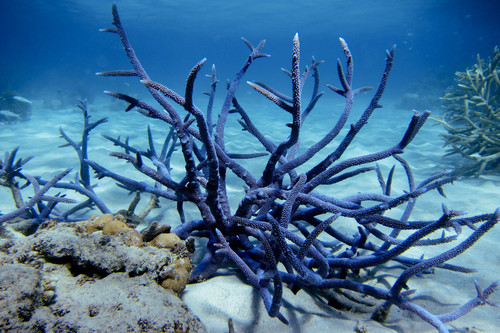
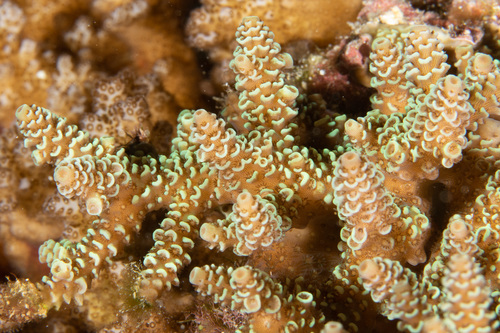
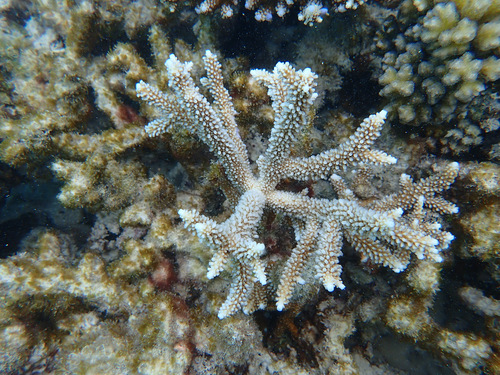
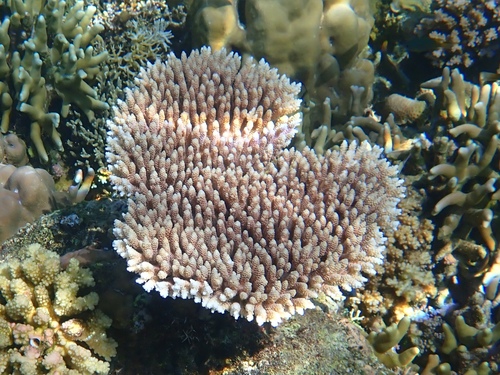
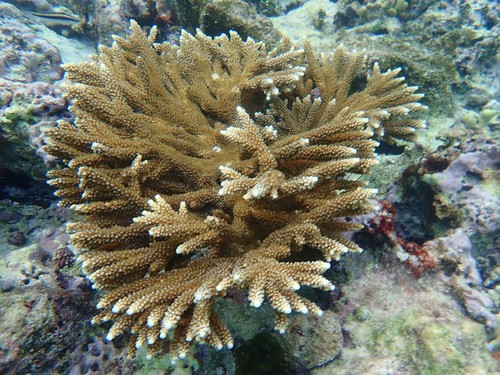
Acropora prolifera looks very similar to staghorn coral (Acropora cervicornis), but it typically forms smaller, denser clumps. Its branches are mostly horizontal, often divide near the tip, and sometimes fuse with other branches. It also resembles elkhorn coral (Acropora palmata), and genetic studies confirm it is a hybrid between elkhorn coral and staghorn coral. Corallites are the calcareous skeletal cups that hold coral polyps. On this species, the corallites are tubular, protrude from the branch surface, are tightly packed, and arranged in linear rows, with one larger corallite located at the tip of each branch. Individual branches grow up to 2 cm (0.8 in) in diameter, and a full colony can reach 1.2 metres (3 ft 11 in) across. The entire colony is generally pale yellowish-brown, with paler colored tips on its branches. This coral is found in the Caribbean Sea, the Gulf of Mexico, the Bahamas, and southern Florida, with its range extending south to Colombia and Venezuela. It typically grows on outer reef slopes, in calm-water bays, and in the lee of land masses. It is most common at a depth of around 7 metres (23 ft), but can occasionally be found as deep as about 30 metres (98 ft). It is generally classified as an uncommon species.