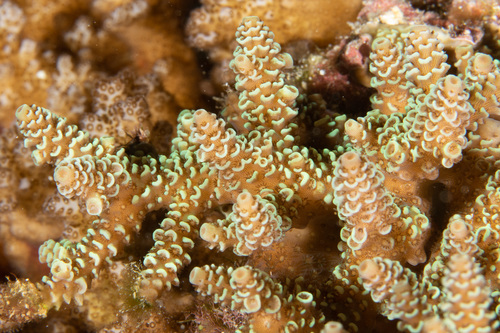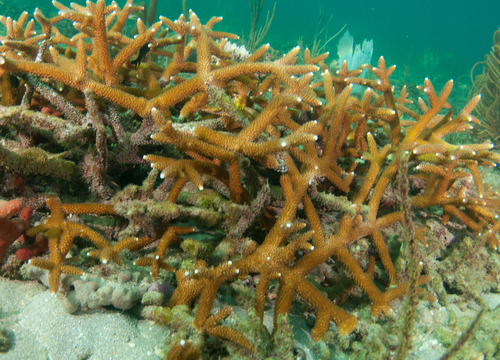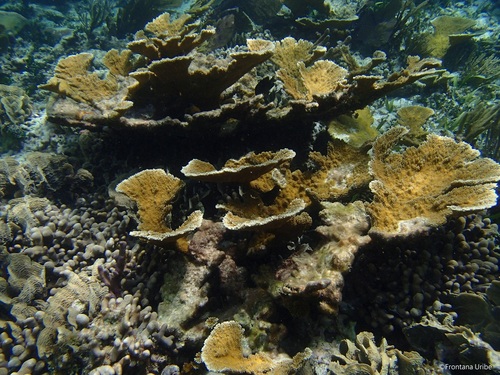
About Acropora palmata (Lamarck, 1816)
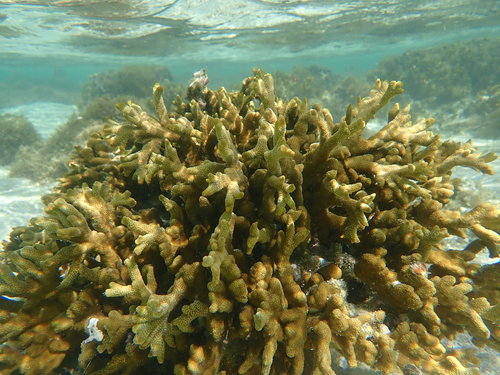
Elkhorn coral, with the scientific name Acropora palmata (Lamarck, 1816), is an important reef-building coral found in the Caribbean. It has a complex branching structure that resembles elk antlers, which gives the species its common name. This branching structure provides habitat and shelter for many other reef species. Elkhorn coral grows quickly, with an average annual growth rate of 5 to 10 cm (2.0 to 3.9 in). It can reproduce both sexually and asexually, though asexual reproduction through fragmentation is far more common. Although Elkhorn coral dominated Caribbean reefs in the early 1980s, the species has experienced a dramatic population decline. Scientists estimate that between 1980 and 2006, when it was evaluated for the Endangered Species Act (ESA), the population fell by around 97%. This decline has been caused by a variety of factors including disease, algae overgrowth, climate change, ocean acidification, and human activity. In May 2006, Elkhorn coral was officially listed as threatened under the ESA, along with another Acropora species, staghorn coral. Some conservation efforts are now in place to protect the species and promote increased genetic variability within its populations. Elkhorn coral lives in shallow habitats that give it abundant access to light. Like all animals, Elkhorn coral needs oxygen to survive; it gets most of this oxygen from special photosynthetic algae called zooxanthellae that live in its tissues. To help their zooxanthellae produce as much oxygen as possible via photosynthesis, Elkhorn coral inhabit shallow regions between 1 and 5 meters deep to ensure abundant light reaches the symbiotic algae. This species is found in clear, shallow water throughout the Bahamas, Florida, the Caribbean, and extends south to the northern shores of Venezuela. The northernmost region where Elkhorn coral lives is off the coast of Broward County, Florida. It is characteristically found in shallow, turbulent water 1 to 5 meters (3 ft 3 in to 16 ft 5 in) deep, and thrives best in high-energy zones with frequent wave action. Wave action increases fragmentation, which allows more new colonies to form, making these high-energy zones ideal for the species. Quantitative data on the historical and present distribution and abundance of Elkhorn coral is scarce. Currently, the species can be found along the southern coasts of Florida, in the northern regions of the Gulf of Mexico, and in the Bay Islands of Honduras. Four critical habitats essential to Elkhorn coral conservation have been designated and protected under the Endangered Species Act. These protected areas include 1,329 square miles of marine habitat in Florida, 3,582 square miles in Puerto Rico, 121 square miles in the St. John/St. Thomas area, and 126 square miles in the St. Croix area. Elkhorn coral is a simultaneous hermaphrodite, meaning each colony produces both eggs and sperm. Despite this, self-fertilization usually does not occur. Two genetically distinct parent colonies are required for successful fertilization. Successful reproduction rates are low in Elkhorn coral, which limits the growth of new colonies. The low success rate occurs because only about 50% of Elkhorn corals are genetically unique individuals. Elkhorn coral's annual reproduction cycle happens once per year, after a full moon in late summer, during July, August, or September. Colonies release gametes via broadcast spawning for only a few nights, releasing eggs and sperm into the water column. Once fertilized, eggs develop into larvae that settle onto hard surfaces and begin growing into new colonies. Asexual reproduction through fragmentation is the most common method of reproduction for Elkhorn coral. During storms, strong wave activity, or ship disturbances, fragments of coral break off and are transported to new locations where they can establish new colonies. New colonies formed this way are genetically identical to their parent colony, while sexual reproduction produces new genetic combinations. Unlike sexual reproduction, which only occurs once annually, fragmentation can happen at any time of year.