About Acropora hyacinthus (Dana, 1846)
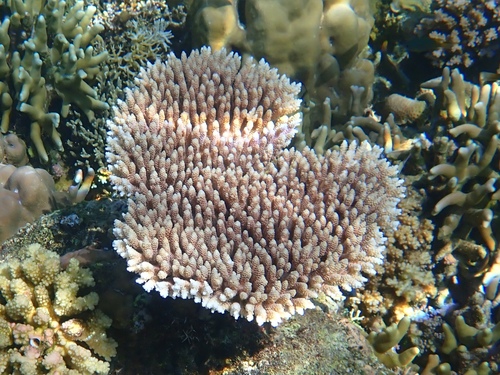
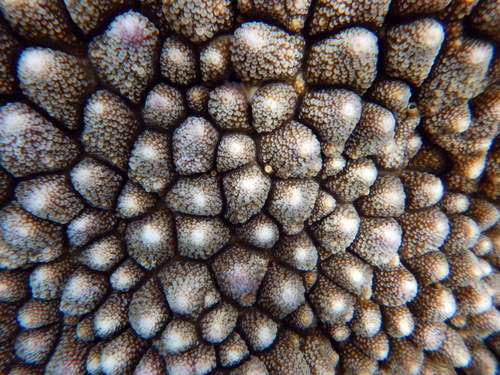
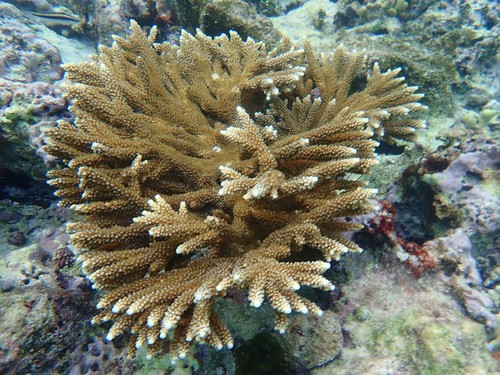
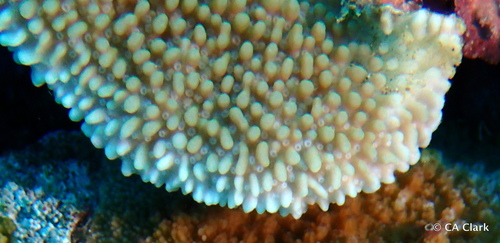
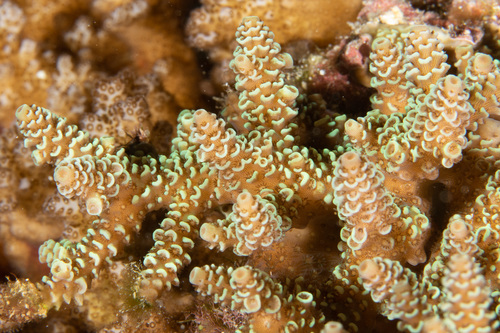
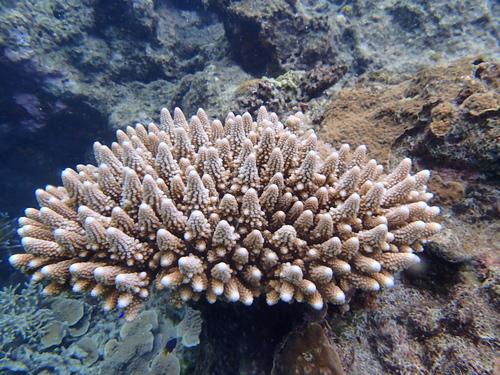
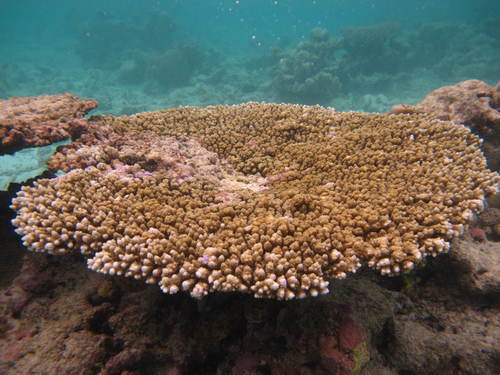
Acropora hyacinthus forms wide, plate- or table-shaped colonies made up of numerous thin branches arranged in a lattice structure. Its branchlets are strongly inclined, and this species has dominant axial branches. Each branch has a large, dominant axial corallite, with much smaller, cup-shaped radial corallites. The corallites of Acropora hyacinthus specimens are often darker than the main branch structure. This species resembles many other tabular Acropora species, and is frequently misidentified when observed in the field. Acropora hyacinthus is distributed across the Central Pacific and along Australia’s east coast. It inhabits the upper slopes of shallow reefs at depths ranging from 1 to 25 meters (3 ft 3 in to 82 ft 0 in). Like most corals, Acropora hyacinthus is classified as a data deficient species on the IUCN Red List. While exact population figures for the species are unknown, its population is thought to be decreasing in line with the global decline of coral reefs. This species is listed under Appendix II of CITES. It is likely threatened by global coral reef reduction, elevated temperatures that cause coral bleaching, climate change, human activity, the crown-of-thorns starfish (Acanthaster planci), and disease.