About Acropora humilis (Dana, 1846)
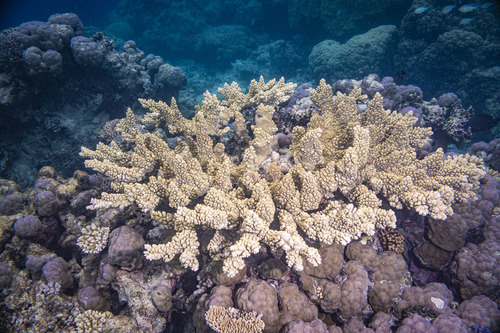
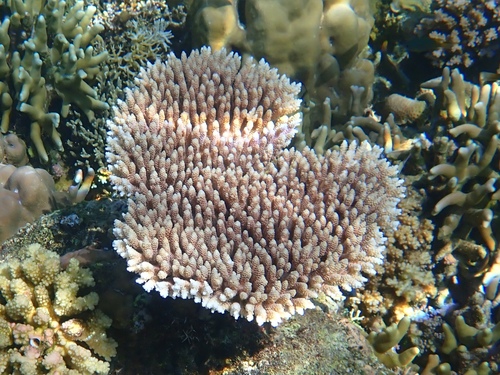
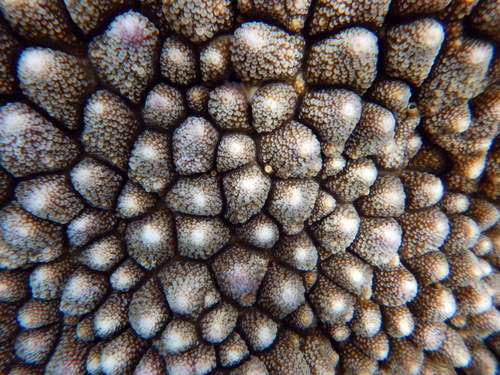
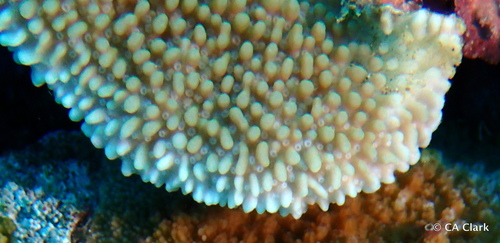
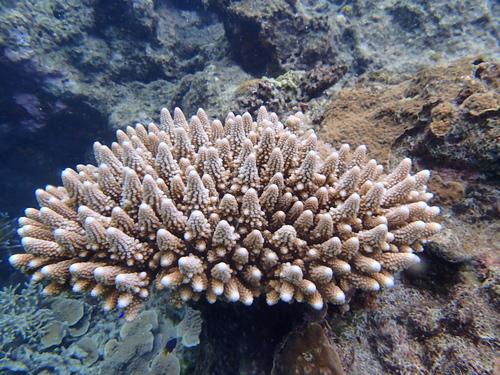
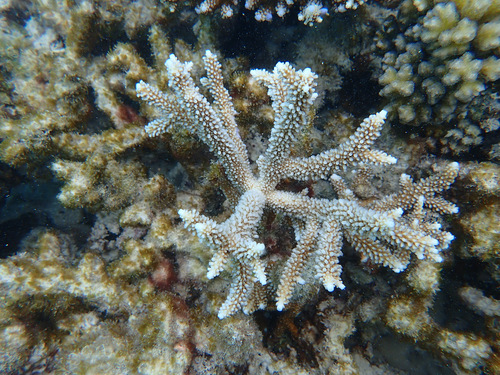
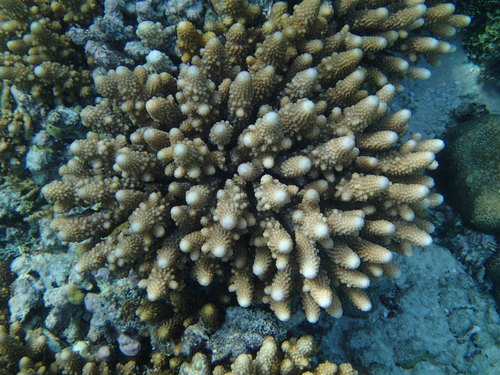
Acropora humilis (Dana, 1846) forms digitate colonies made up of thick, tapering branches. Each branch holds one or more large, dome-shaped axial corallites. At the base of these branches, the species has either incipient axial corallites or branchlets. Its radial corallites come in two distinct diameters, and the larger radial corallites are arranged in rows. The species is most commonly cream, blue, brown, or purple in overall colour, and its branches have cream or blue tips. This species is classified as Near Threatened on the IUCN Red List, and its population is thought to be decreasing. It is also listed under Appendix II of CITES. No specific population figures are currently available for this species. It is likely threatened by global coral reef loss, rising temperatures that cause coral bleaching, climate change, human activity, the crown-of-thorns starfish (Acanthaster planci), and disease. It occurs in the Gulf of Aden, the Red Sea, the northern and southwestern Indian Ocean, Australia, the central Indo-Pacific, Japan, southeast Asia, the East China Sea, and the central and western Pacific Ocean, including Johnston Atoll, the northwestern Hawaiian Islands, the Raja Ampat Islands, the Mariana Islands, Palau, and the Pitcairn Islands. It grows at depths up to 12 metres (39 ft) on tropical upper reef flats and slopes, and is exported for use in aquariums.