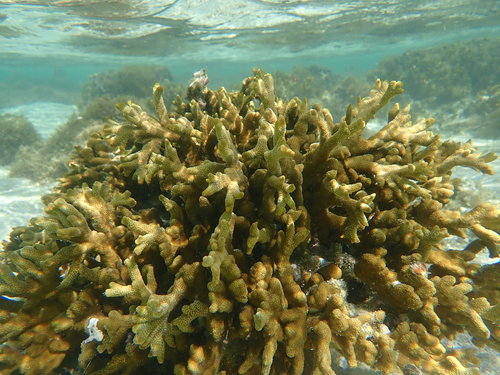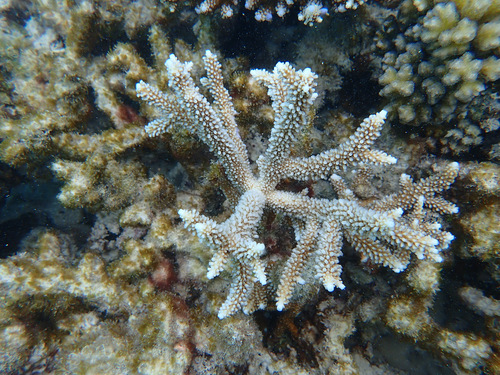
About Acropora cervicornis (Lamarck, 1816)
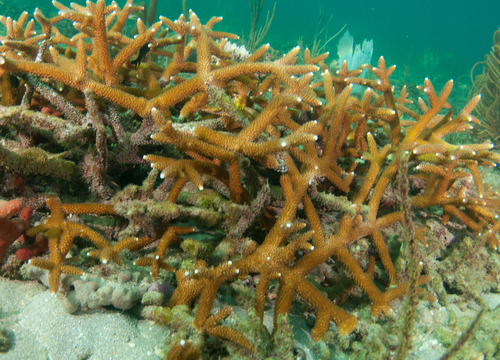
Scientific name: Acropora cervicornis (Lamarck, 1816), common name staghorn coral. Candidate identification under the Endangered Species Act of 1973 (ESA): On June 11, 1991, both Staghorn and Elkhorn coral were first identified as candidates for reclassification under the ESA. On December 18, 1997, both species were removed from the candidate list for listing, because evidence about their biological status or threats was unavailable. On June 23, 1999, both species were added back to the candidate list for potential ESA listing, after new evidence emerged showing large-scale population decline compared to historic levels.
Geographic location: Staghorn coral is found throughout the Western Atlantic Ocean, ranging from the Florida Keys and the Bahamas to the coasts of various Caribbean islands. It occurs in the western Gulf of Mexico, but is absent from U.S. waters in the Gulf of Mexico, as well as from Bermuda and the west coast of South America. The northern limit of this species' range is Palm Beach County, Florida, where only small populations have been documented.
Habitat: Staghorn coral is most commonly found within 20 meters (65 ft) of the water's surface, in clear, non-turbid environments on fore reefs, back reefs and patch reefs in the Western Atlantic Ocean. In this environment, water temperatures typically range from 66 to 80 degrees Fahrenheit (19 - 27 degrees Celsius), with salinity ranging from 33 to 37 parts per thousand (ppt).
Reproduction: Staghorn corals reproduce through two methods: asexual reproduction and sexual reproduction.
Asexual reproduction: Asexual reproduction most typically involves budding and fragmentation. Budding is the process through which a single coral colony grows, and it includes two types of polyp budding. The first, called intra-tentacular budding, is the formation of new polyps from internal splitting of existing polyps. The second, called extra-tentacular budding, is the formation of new polyps from tissue where none existed before, including the space around or between existing polyps. Budding produces polyps genetically identical to those already in the colony, meaning all polyps in a colony are clones of each other. Fragmentation is the process through which an entire coral colony produces one or more new colonies. This process involves branches breaking off from existing Staghorn coral colonies, then implanting and growing on nearby substrates. Like other stony corals, this is the most common mode of reproduction for Staghorn corals, and can allow a single coral to produce many new colonies, or sometimes even entirely new coral reefs. Fragmentation can occur at any time, and is usually caused by turbulent flow from storms, nearby ships, dredging, or any water disturbance that causes coral branches to break and then re-implant. Because of how fragmentation works, all new colonies are genetic clones of the original, which can result in entire Staghorn coral reefs being genetically identical, potentially making them more susceptible to disease or bleaching.
Sexual reproduction: Like the majority of stony coral species in the genus Acropora, Staghorn coral is a simultaneous hermaphrodite, meaning each individual polyp produces both female and male gametes. Although they technically have the ability to self-fertilize, research suggests that single colonies are either completely or partially self-sterile. Therefore, two distinct colonies (two parents) are needed to successfully produce coral planula. Eggs and sperm are released in a synchronized event called broadcasting. This improves the success of fertilization and production of fertile offspring. Staghorn coral spawning is typically restricted to late summer, in the months of July and August, and occurs several days after a full moon. The mechanism these corals use to choose a spawning day is still unknown, but it is almost certainly influenced by multiple factors including water temperature, the lunar cycle, wave action and tidal periods.