About Acronychia oblongifolia (Hook.) Endl.
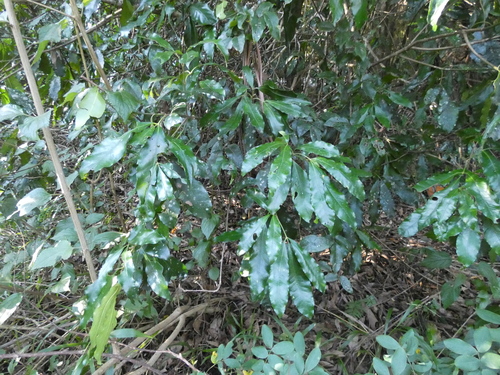
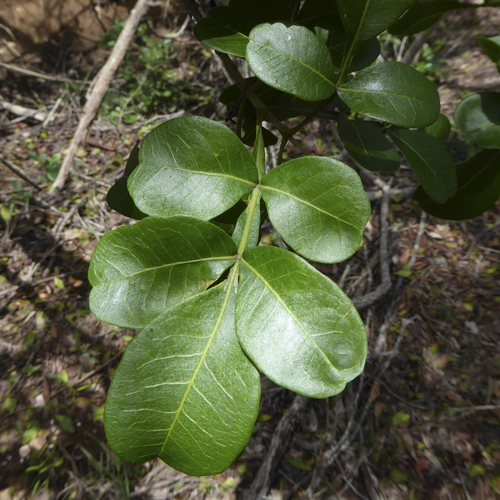
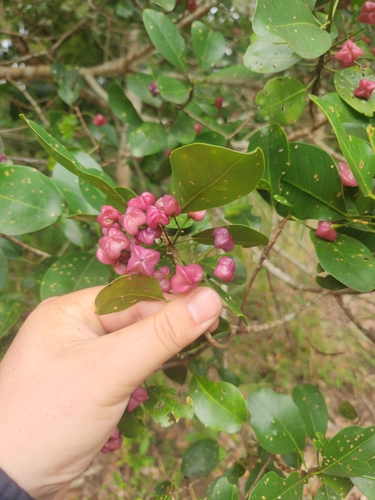
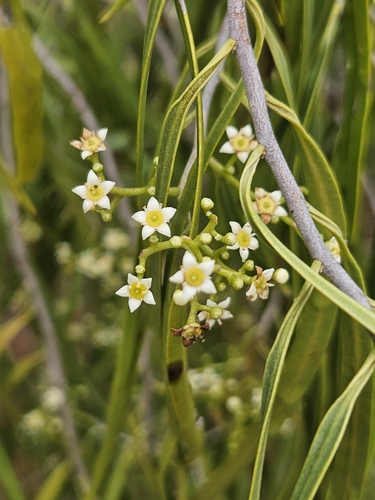
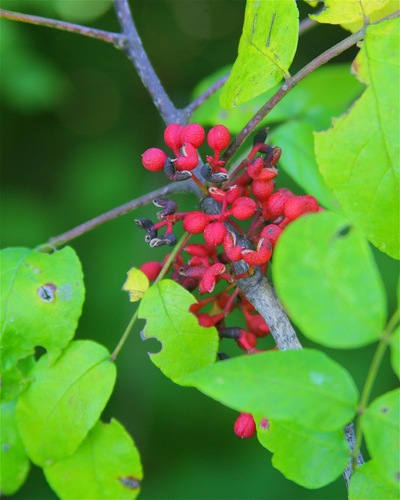
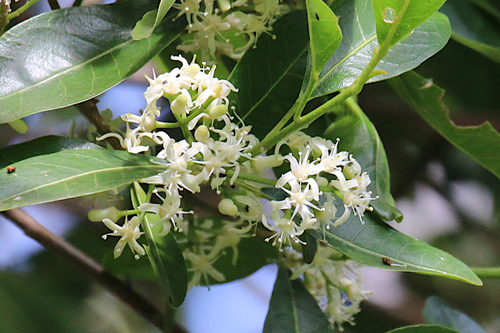
Acronychia oblongifolia (Hook.) Endl., commonly known as white aspen, grows as a shrub or medium-sized tree, sometimes reaching 27 m (89 ft) in height. Its trunk is dark brown, generally smooth, and sometimes marked with fine wrinkles, fissures or pustules. Leaves are mostly simple, arranged in opposite pairs, shaped like a lance or egg with the narrower end toward the base, measuring 30–120 mm (1.2–4.7 in) long and 14–50 mm (0.6–2 in) wide, on a 5–32 mm (0.2–1 in) long petiole. Leaves are leathery, dark green, aromatic, and occasionally trifoliate. The creamy-white flowers are arranged in small groups 20–60 mm (0.8–2 in) long, usually growing in leaf axils. Each flower is about 10 mm (0.4 in) wide, on a 1.5–8 mm (0.06–0.3 in) long pedicel. The plant has four sepals 0.9–1.5 mm (0.04–0.06 in) wide, four petals 4.5–7 mm (0.2–0.3 in) long, and eight stamens that alternate in length. Flowering occurs from February to June. The fruit is a fleshy, more or less spherical drupe that is white, yellow or purplish, measuring 5–9 mm (0.2–0.4 in) long. Fruits mature from May to December, are four-lobed, and have a tuft of hairs at the end. White aspen is distributed from near Gympie in central-eastern Queensland, south through eastern New South Wales, to a small number of rainforest communities in eastern Victoria. Its natural habitat is rainforest and rainforest margins. The plant most often grows in a shrubby form; it reaches full tree size in rainforests of the McPherson Range on the New South Wales/Queensland border, and in the Mitchell River Gorge in Victoria. Ripe fruits are available between May and November, or until January in Victoria, and are eaten by the green catbird, regent bowerbird, satin bowerbird, pied currawong, topknot pigeon, white-headed pigeon, blue-faced honeyeater and wompoo fruit dove. In horticulture, Acronychia oblongifolia is fairly easy to cultivate in well-drained soil with a sunny position, and benefits from additional water and fertiliser. Young plants are somewhat sensitive to frost. It can be propagated by seed or cutting. For food use, the berries are reported to have an aromatic lemon-orange flavour. They can be served in salads and side dishes, or cooked with seafood or poultry, and can also be used in preserves, sauces, juices and cocktails.