About Acronychia laevis J.R.Forst. & G.Forst.
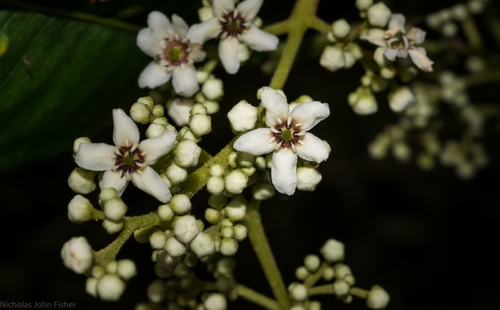
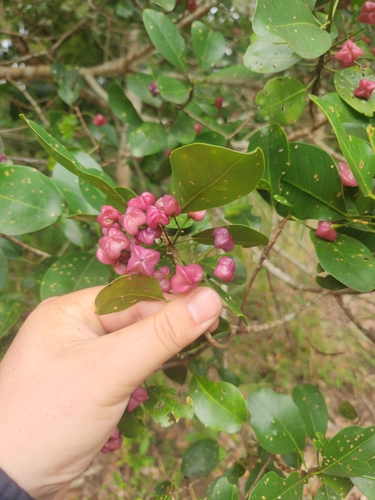
Acronychia laevis J.R.Forst. & G.Forst. is a shrub or small tree that usually reaches 12 metres (39 feet) in height. Its trunk has fairly smooth, fawn-colored bark marked with vertical lines and wrinkles. Leaves are arranged in opposite pairs, are simple, and range from elliptic to egg-shaped with the narrower end at the base. They measure 25–100 mm (0.98–3.94 in) long and 10–50 mm (0.39–1.97 in) wide, growing from a petiole 3–30 mm (0.12–1.18 in) long. Both sides of the leaves are shiny green, with a blunt or rounded tip, and contain oil dots that are visible with a magnifying lens and bright light. Flowers are most often arranged in cymes in leaf axils, with cymes 15–70 mm (0.59–2.76 in) long, and each flower grows from a pedicel 3.5–13 mm (0.14–0.51 in) long. This species has four sepals 0.5–1.5 mm (0.020–0.059 in) wide, four creamy white petals 5–9 mm (0.20–0.35 in) long, and eight stamens that alternate in length. Flowering takes place from February to June. The fruit is a fleshy drupe ranging from mitre-shaped to roughly spherical, dark pink in color, 7–10 mm (0.28–0.39 in) long, and contains reddish-brown seeds around 4 mm (0.16 in) long. This species, commonly called hard aspen, grows in dry rainforest and subtropical rainforest, from sea level up to an altitude of 1,100 m (3,600 ft). It occurs from the upper Clarence River, New South Wales north to Cape York Peninsula in Queensland, and also grows on New Caledonia and Lord Howe Island. The fruit of Acronychia laevis is eaten by the green catbird. In horticulture, Acronychia laevis can be cultivated in a sunny or partially shaded garden position, and has horticultural appeal thanks to its attractive flowers and fruit. It can be propagated from seed, and propagation from cuttings may also be attempted. The fruit is edible to humans, but it is described as too pungent to be palatable, and its flavor has even been compared to turpentine.