About Acronicta rumicis Linnaeus, 1758
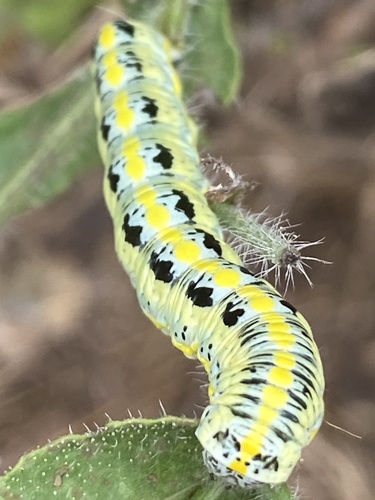
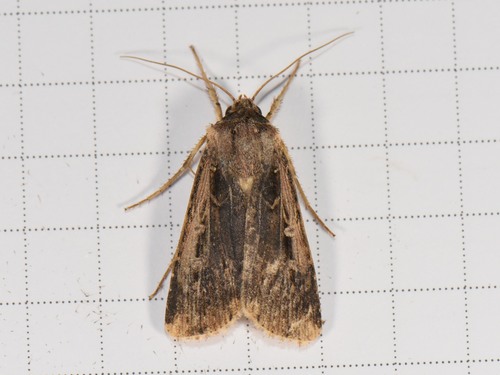
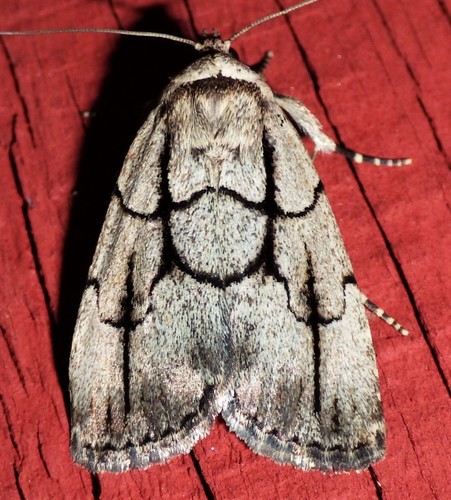
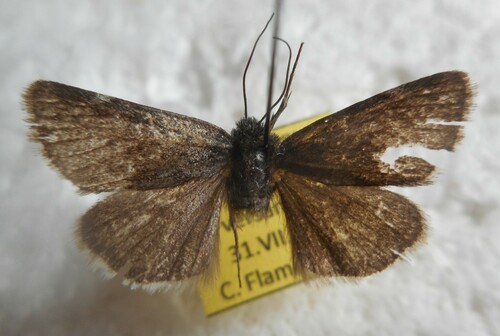
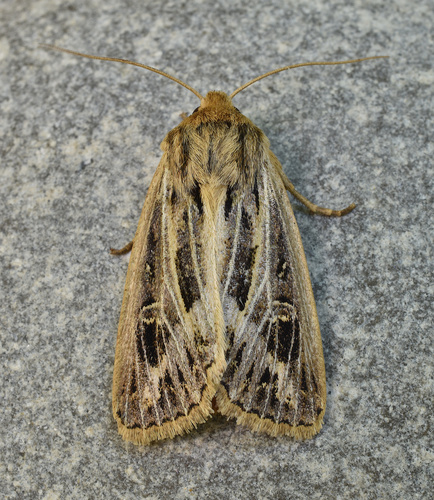
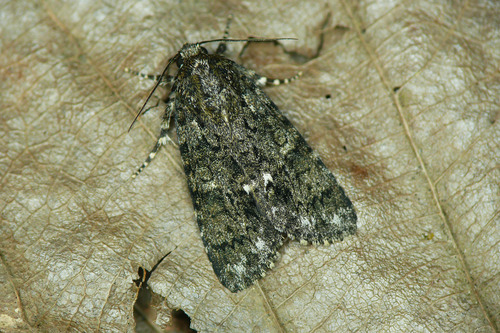
Acronicta rumicis Linnaeus, 1758 has a wingspan ranging from 34 to 44 mm. Its forewings are blotched with a mix of dark and light grey shades, while its hindwings are dark brown. A distinct white spot located midway along the trailing edge of the forewing marks this species, and this marker does not appear in other Acronicta moths. Moths from China and Japan are typically larger than European individuals, and these Asian moths also have darker grey shades on their lower forewings. In more technical terms, the forewing of this species is dark grey, with whitish variations in some areas, black lines and shades, and a white spot on the outer line at the submedian fold. The hindwings are brownish fuscous. The larva is marbled dark and light grey, with a dorsal row of red spots set on black blotches, a row of white spots on each side, a pale line below the spiracles that holds orange-red tubercles, and humped dorsum on the fifth and twelfth segments. Tubercles bear fascicles of fuscous and fulvous hairs. turanica Stgr., a form from Central Asia, is much paler and has whitish hindwings. Chinese and Japanese specimens are larger than European ones and consistently darker, especially with a blacker lower half of the forewing; the white spot on the outer line is often obscured in these individuals. It is possible that the melanic scotch form Curtis figured as salicis matches this aberration, though the larva figured alongside it is unquestionably that of menyanthidis. The aberration ab. alnoides Geest has a grey costal half of the forewing and a blackish inner half, interrupted by a strong black dagger-shaped mark at the base and above the anal angle; it superficially resembles a dark grey alni, and has been recorded from Freiburg in Baden. The aberration ab. euphorbiae Steph. nec. Hbn. is grey brown, with pale stigmata and pale space between the stigmata. The aberration ab. euphrasiae Steph. nec Dup. is pale yellowish grey with numerous black lines and a faint or absent orbicular stigma, and occurs in Cornwall. This species is distributed across the Palearctic. It is common in northwestern China, the Korean Peninsula, and Japan, and also occurs across other parts of Eurasia including Russia. It is found in nearly all of Europe, but is absent from some areas of north-western Scandinavia. There has been extensive research on this species in England and Scotland. These moths live on plants in open areas including meadows, woodland clearings, gardens, and hedgerows, generally favoring non-humid areas. According to researcher Emma Coulthard, hedgerows located close to crops and farmland are extremely important for the survival of species like Acronicta rumicis. Hedgerows provide food resources, shelter, and egg-laying sites for female moths. Recent studies also indicate that hedgerows may act as navigation guides when these moths fly between locations. Since these moths are nocturnal, they most likely do not rely on visual cues for navigation, and instead follow olfactory markers. In recent times, many hedgerows have been removed to increase agricultural efficiency. Removing this key habitat not only removes basic survival resources such as food and shelter, but also disrupts the moths' navigation. Moths lose their navigational trail and may potentially die as a result. Even small gaps between hedgerow sections can cause moths to become lost, and a gap of just one metre of missing hedgerow can have an impact. For this reason, it is important for agricultural workers to find ways to advance their agricultural goals while preserving the habitats of moths such as Acronicta rumicis.