About Acromitus flagellatus (Maas, 1903)
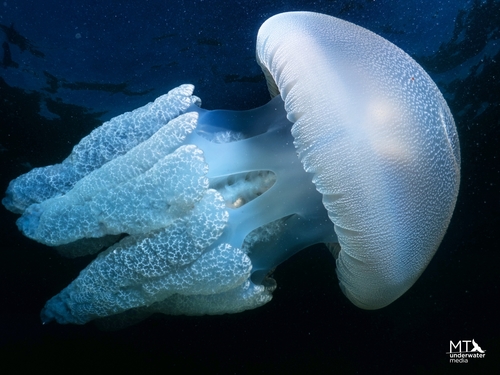
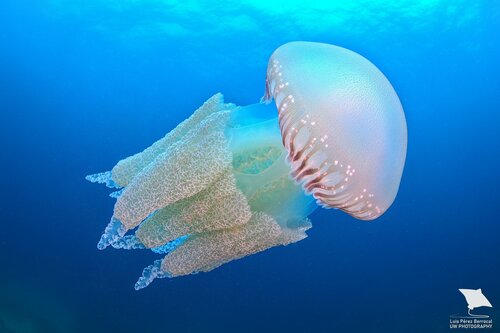
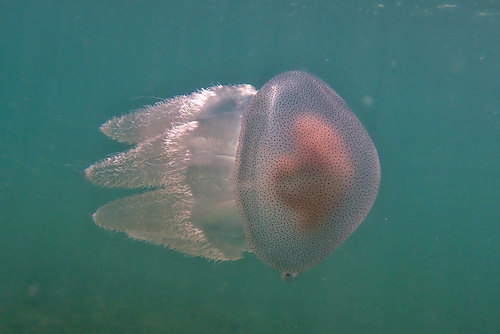
The exumbrella of Acromitus flagellatus has a diameter of 160 ± 40 mm, and is covered in uneven black or brown spots. This species has eight oral arms, each approximately 115 ± 45 mm long, with a long flagellum at the tip of each arm. Medusae of Acromitus flagellatus may be white, grey, pink, or transparent. Stings from this species have little to no effect on humans. Acromitus flagellatus moves sluggishly, with very slow body contractions, and is sometimes assisted in movement by Caranx leptolepis. Acromitus flagellatus inhabits brackish water environments including mangroves, estuaries, and coasts. Specimens have been recorded in the Bay of Bengal, the Saptamukhi river channel, and the coastal waters of Hainan Province, and the species occurs most widely across the Western Indian Ocean and Central Pacific Ocean. Acromitus flagellatus is a gonochoristic species that reproduces sexually. The life cycle progresses as follows: a parent medusa lays an egg, which develops into a planula, then a scyphistoma, then a strobila, and finally reaches the mature medusa stage. Acromitus flagellatus cannot feed during the egg and strobila stages of its life cycle, meaning it only feeds during every second stage of its life cycle.