About Acrolepia assectella (Zeller, 1839)
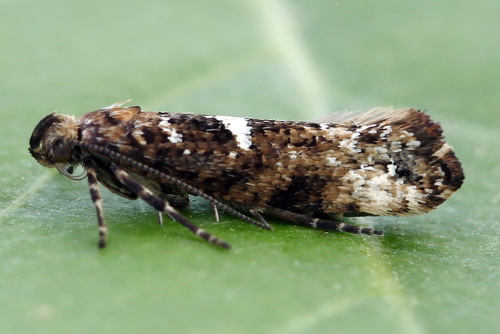
Commonly called the leek moth, this species has the scientific name Acrolepia assectella (Zeller, 1839). Its wings are brown mottled with white spots, and measure about 12 mm across when fully spread. Significant individual variation in wing pattern can make this moth hard to tell apart from other Acrolepiopsis species at first glance, but its distinct genitalia allow for easy identification. Males can be identified by their long saccus, a portion of the male genitalia used to grasp females, while females are identifiable by their long, flat ductus bursae, a structure in the female reproductive tract. The leek moth is native to Europe, where it occurs across the whole continent. Its range reaches northwestern to Scandinavia and northeastern to Russia, and extends south to Algeria. It is an invasive species in North America, first discovered in Canada in 1993. Since its introduction, its North American range has grown to include parts of Ontario, Quebec, Prince Edward Island, New York, and Nova Scotia. Climate models indicate that the leek moth's range could continue expanding to cover more of eastern North America. Development time from egg to adult varies with temperature, generally ranging from 3 weeks at higher temperatures to 6 weeks at lower temperatures. The number of generations the species can produce each year also depends on local climate conditions. Three or more generations can typically be completed per year in Ontario, France, and Poland, while only two generations can be completed in Sweden. Adults emerge in spring, and lay eggs within 10 days of reaching adulthood. Eggs are laid on the leaves of the larval host plant. First instar larvae mine into these leaves, then go on to complete five total instars. Mature larvae reach a length of 13–14 mm, and are light yellow-green with a brownish-yellow head. Once mature, fifth instar larvae leave the host plant and spin a white cocoon, either on the host plant or in a nearby location. The pupa inside the cocoon is reddish-brown. If daylengths during earlier larval stages are shorter than 15 hours, newly emerged adults will enter diapause to overwinter. If daylengths are longer, adults will lay a new generation of eggs.