About Acrocodia indica (Desmarest, 1819)
Scientific name: Acrocodia indica (Desmarest, 1819)
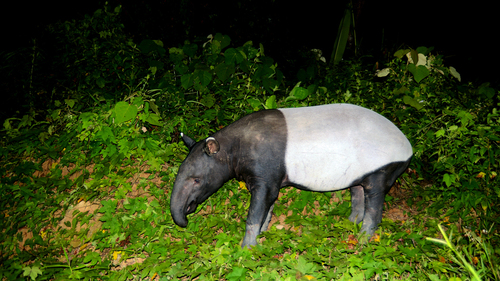
Description: The Malayan tapir is easily identified by its distinctive markings, most notably a light-colored patch that stretches from its shoulders to its hindquarters. Black fur covers its head, shoulders, and legs, while white fur covers its midsection, rear, and the tips of its ears. Like other tapirs, it has white edges along the rims of its outer ears. This broken-up color pattern disrupts the tapir's outline, acting as camouflage that makes the animal hard to recognize against the varied terrain and dense plant life of its habitat. When the tapir lies down to sleep, potential predators may mistake it for a large rock instead of prey.
The Malayan tapir is the largest of the four living tapir species. It reaches between 1.8 and 2.5 m (5 ft 11 in to 8 ft 2 in) in body length, not counting its stubby tail that measures only 5 to 10 cm (2.0 to 3.9 in) long. It stands 90 to 110 cm (2 ft 11 in to 3 ft 7 in) tall at the shoulder. It typically weighs between 250 and 320 kg (550 and 710 lb), though some adult individuals can weigh as much as 540 kg (1,190 lb). Females are usually larger than males. Like other tapir species, it has a small, stubby tail and a long, flexible proboscis. It has four toes on each front foot and three toes on each back foot. The Malayan tapir has rather poor eyesight, but excellent hearing and a strong sense of smell.
The tapir's unique proboscis is supported by several evolutionary adaptations of its skull. It has a large sagittal crest, unusually positioned eye sockets, an unusually shaped cranium with elevated frontal bones, a retracted nasal incision, and retracted facial cartilage. This evolutionary process is thought to have caused the loss of some cartilages, facial muscles, and the bony wall of the tapir's nasal chamber.
Distribution and habitat: The Malayan tapir lives in primary and secondary lowland tropical forests across Southeast Asia, including Sumatra in Indonesia, Peninsular Malaysia, Myanmar, and Thailand. Pleistocene fossils have been found in Java and other locations alongside herbivores more typical of grasslands, which indicates the species evolved in more open habitats before retreating to closed forests in later periods. It existed in Borneo until at least 8,000 years ago during the early Holocene at the Niah Caves of Sarawak, and some 19th century writers noted it as a modern species on Borneo, likely based on native accounts. It has been proposed that the tapir be reintroduced to the island as a conservation measure. In mainland Asia, the Malayan tapir ranged as far north as China in historical times.
Behaviour and ecology: Malayan tapirs are primarily solitary, marking out large tracts of land as their territory, though these territories usually overlap with the ranges of other individuals. Tapirs mark their territories by spraying urine on plants, and they often travel along distinct paths that they have bulldozed through dense undergrowth. The species is exclusively herbivorous, foraging for the tender shoots and leaves of more than 115 plant species, around 30 of which are particularly preferred. It moves slowly through the forest, pausing often to eat and detect scents left by other tapirs in the area. When threatened or frightened, the tapir can run quickly, and if forced to fight it can defend itself with its strong jaws and sharp teeth. Malayan tapirs communicate using high-pitched squeaks and whistles. They usually prefer to live near water, often bathe and swim, and are also able to climb steep slopes. Tapirs are mainly active at night, though they are not exclusively nocturnal. Because they tend to feed soon after sunset or before sunrise, and often nap in the middle of the night, they are categorized as crepuscular animals.
Life cycle: The gestation period of the Malayan tapir is around 390–395 days, after which a single calf is born that weighs roughly 6.8 kg (15 lb). Malayan tapir calves are the largest of the four tapir species at birth, and tend to grow more quickly than their close relatives. Young tapirs of all species have brown fur patterned with white stripes and spots, a pattern that lets them hide effectively in the dappled light of the forest floor. This juvenile coat fades into the adult color pattern between four and seven months after birth. Weaning takes place between six and eight months of age, by which time the young tapirs are nearly full-grown. Malayan tapirs reach sexual maturity around three years of age. Breeding typically occurs in April, May, or June, and females generally produce one calf every two years. Malayan tapirs can live up to 30 years, both in the wild and in captivity.