About Acrocephalus orientalis (Temminck & Schlegel, 1847)
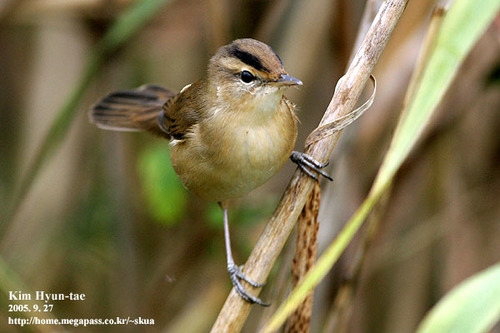
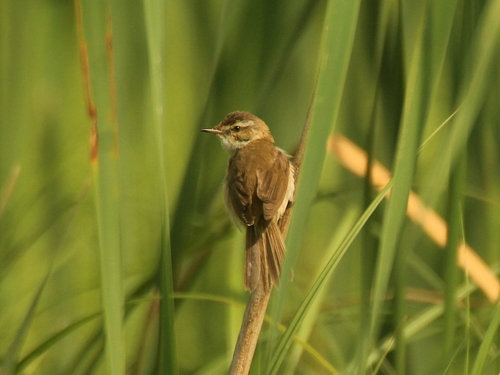
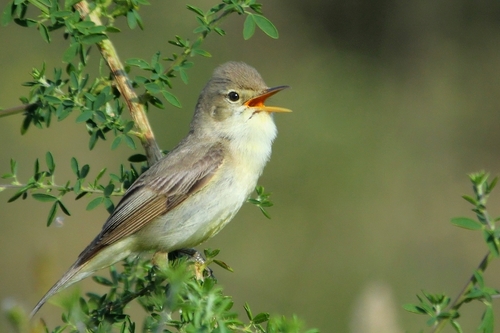
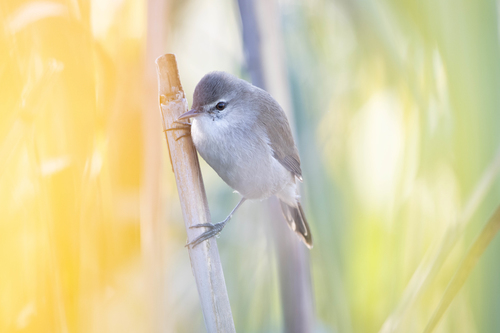
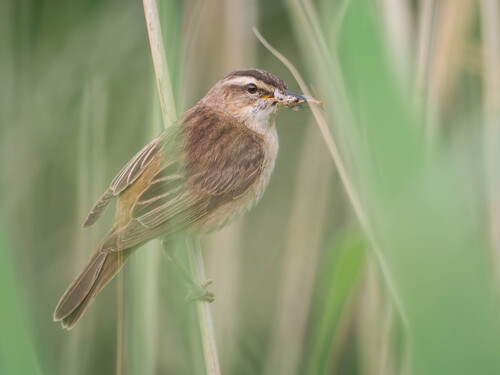
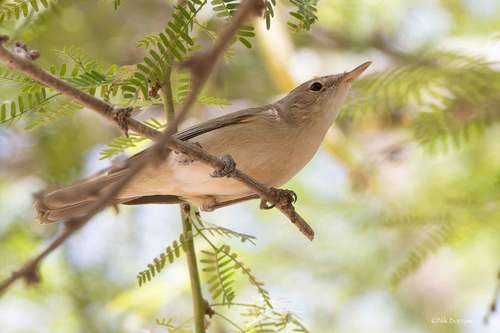
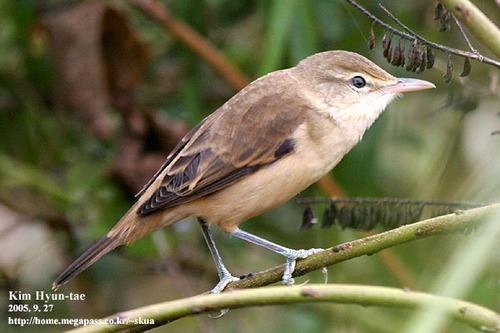
This species, the Oriental reed warbler with the scientific name Acrocephalus orientalis (Temminck & Schlegel, 1847), is a large warbler that measures 18–20 cm in length with a wingspan of 23–26 cm. Its upper plumage is brown, with a paler rump and whitish tips on the tail feathers. Its underparts are whitish, with brown coloration on the flanks and undertail-coverts. Narrow greyish streaks are present on its throat and breast. It has a dark eyestripe and a whitish stripe above the eye. Its fairly long, heavy bill is brownish on the upper side and pink on the lower side, with a bright orange gape. Its feet are grey. Compared to the great reed warbler, it is slightly smaller, more slender, and has shorter wings. Compared to the clamorous reed warbler (A. stentoreus), its tail is shorter and more square-ended, it has a slightly longer primary projection, and a slightly shorter and thicker bill. The pale tip on its tail distinguishes this species from both the great reed warbler and the clamorous reed warbler. Its song is a mix of warbling phrases and guttural, croaking notes, and it sings from a prominent perch such as the top of a reed stem or bush. This species also has a loud, harsh chack call. Its breeding range spans southern Siberia, Mongolia, northern, central and eastern China, Korea, and Japan. It winters in north-east India, and across South-east Asia to the Philippines and Indonesia, occasionally reaching New Guinea and Australia. It has been recorded as a vagrant in Israel and Kuwait. It breeds mainly in reedbeds, and can also be found in marshes, paddy fields, grassland, and scrub, where it forages for insects and other invertebrates. Oriental reed warblers hold small breeding territories and can reach high population densities. The nest is built 1–1.5 metres above ground among reed stems. Females lay two to six eggs, which are incubated for 12 to 14 days. Young birds fledge 10 to 15 days after hatching. Major predators of nests include the Siberian weasel, cats, and snakes of the genus Elaphe.