About Acrocephalus agricola (Jerdon, 1845)
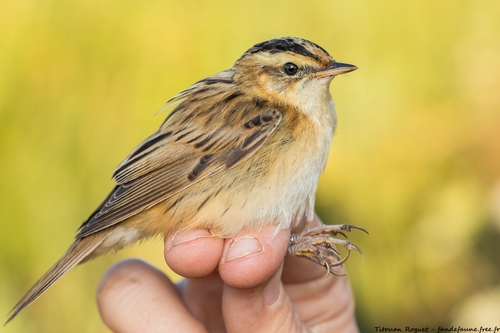
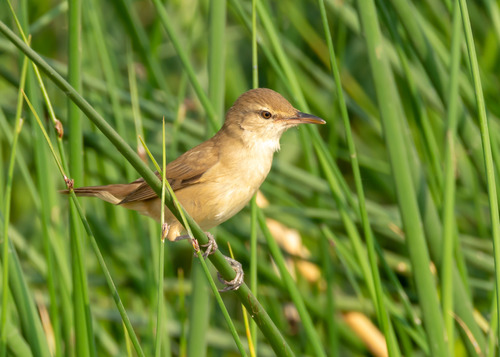
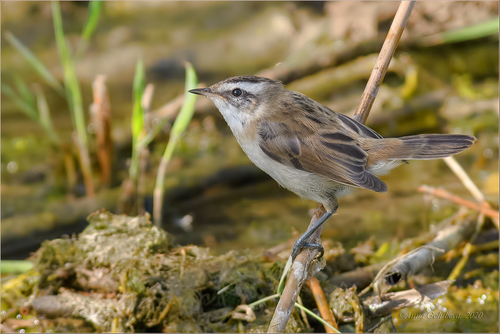
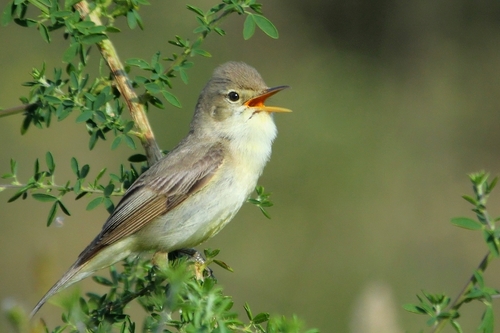
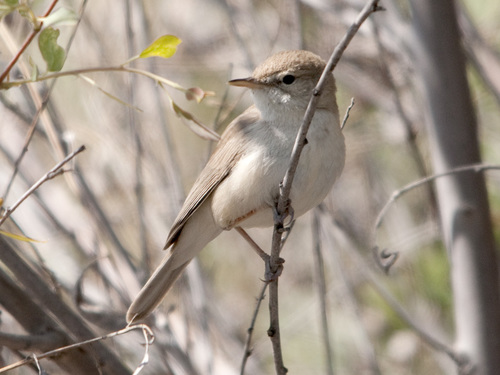
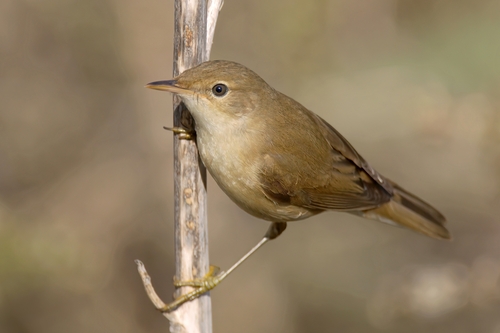
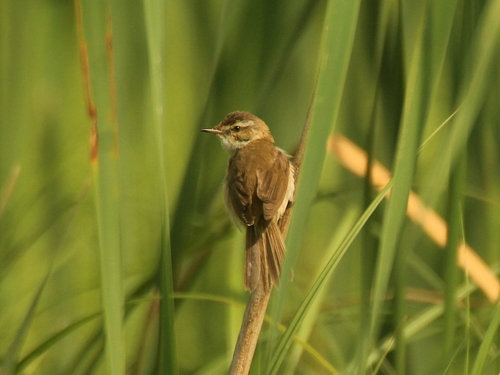
The paddyfield warbler, with the scientific name Acrocephalus agricola, is a species in the marsh warbler family Acrocephalidae. It was previously grouped with the assemblage known as "Old World warblers". The Manchurian reed warbler (A. tangorum) was once classified as a subspecies of paddyfield warbler, and this classification is still sometimes used today. The genus name Acrocephalus comes from the Ancient Greek terms akros, meaning "highest", and kephale, meaning "head". It has been suggested that Naumann and Naumann believed akros meant "sharp-pointed". The specific epithet agricola is Latin for "farmer". Paddyfield warblers breed in the temperate central Palearctic. They are migratory birds, and spend the winter in Bangladesh, India and Pakistan. They are rare vagrants to western Europe, though small breeding populations exist along the western shores of the Black Sea near the border between Bulgaria and Romania. This passerine bird lives in areas with low vegetation, including long grass, reeds, and rice paddies. It lays 4 to 5 eggs in a nest built in grass. It measures 13 cm (5.1 in) in length, with a wingspan of 15–17.5 cm (5.9–6.9 in). It is similar in size to the Eurasian reed warbler, but has a shorter bill and shorter wingspan. Adults have an unstreaked pale brown back, buff underparts, and a warm brown rump. They have a distinct whitish supercilium, and a short, pointed bill. Like most warblers, male and female paddyfield warblers look identical, while young birds have richer buff colouring on their underparts. Like most warblers, paddyfield warblers are insectivorous. Their song is fast, similar to the marsh warbler's song, and includes extensive mimicry alongside whistles that are typical for the Acrocephalus genus. Compared to the marsh warbler's song, the paddyfield warbler's song is weaker and more rhythmic.