About Acritillas indica (Jerdon, 1839)
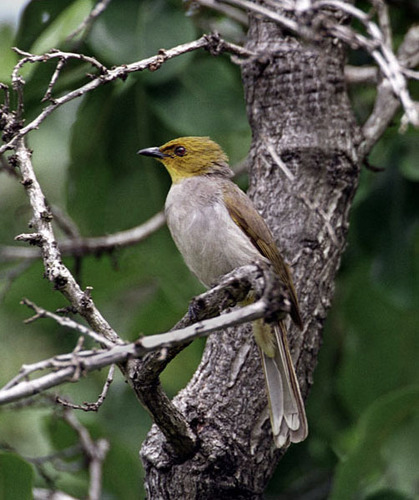
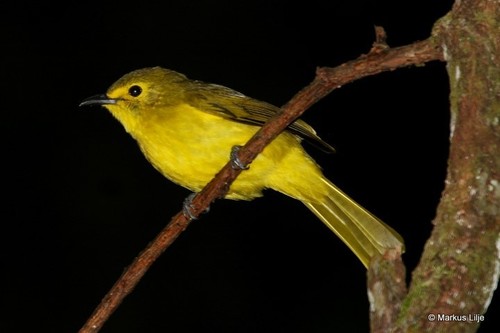
This species of bulbul, Acritillas indica, measures approximately 20 cm (7.9 in) in length. It has no crest, with olive-green upperparts, a prominent yellow brow and yellow goggle-shaped marking around the eye, and entirely yellow underparts. Male and female individuals have identical plumage. The bill is black, and the iris is reddish brown. The subspecies found in the northern Western Ghats (ssp. icterica) has paler yellow plumage than subspecies populations further south (ssp. indica). A somewhat disconnected population of this species lives in the Eastern Ghats. Southwestern Sri Lankan populations (ssp. gugliemi) are greener in color, while northern Sri Lankan populations are classified under the nominate subspecies. The species' calls include a whistle-like call and sharp pick-wick notes. The yellow-browed bulbul is regarded as the wet-zone ecological counterpart to the dry-zone white-browed bulbul. It occurs mainly beneath the forest canopy in hill forests and plantations across the Western Ghats and Sri Lanka. It is also found in parts of the Eastern Ghats, including the Kolli hills, Nallamalas, and parts of the Tirupathi and Mamandur regions of Andhra Pradesh. Yellow-browed bulbuls live in pairs or small groups and call loudly. They feed primarily on berries and insects. The breeding season takes place during the dry period before the monsoons, mostly between January and May. The nest is cup-shaped, built in a low tree fork, and covered on the outside with moss and cobwebs; this gives it the appearance of a large white-eye nest. The nest is lined with fine root fibres. The typical clutch size is three eggs in India, and two eggs in Sri Lanka. A study of 153 nests in India's Silent Valley National Park found that 92% of nests held two eggs. Peak breeding activity in Silent Valley National Park, Kerala, occurs in January and February. Nest building takes about one week, and eggs are incubated for approximately 13 days. Eggs are pale pink or white with reddish brown speckling. Eggs hatch synchronously, and nestlings fledge after about 13 days. Nestlings are fed caterpillars, soft insects, and berries.