About Acridotheres tristis (Linnaeus, 1766)
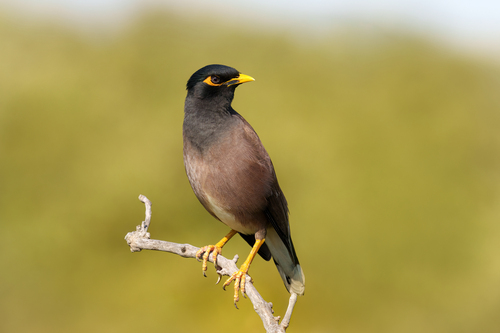
The common myna (Acridotheres tristis) can be easily identified by its brown body, black hooded head, and bare yellow patch behind the eye. Its bill and legs are bright yellow. It has rounded wings and a round tail with a square tip. There is a white patch on the outer primaries, the underside wing lining is white, and the tail also has a white tip. Males and females have similar appearances, and common mynas are usually seen in pairs. The common myna follows Gloger's rule: populations from northwestern India tend to be paler than the darker populations found in southern India. The common myna is native to Asia, with its original native range covering Iran, Pakistan, India, Nepal, Bhutan, Bangladesh, Sri Lanka, Afghanistan, Uzbekistan, Tajikistan, Turkmenistan, Myanmar, Malaysia, Singapore, peninsular Thailand, Indochina, Japan (including mainland Japan and the Ryukyu Islands), and China. As of February 2022, the common myna has been introduced to many other regions across the world, including Canada, Australia, Turkey, Israel, New Zealand, New Caledonia, Fiji, the United States (only South Florida), South Africa, Kazakhstan, Kyrgyzstan, Uzbekistan, the Cayman Islands, multiple islands in the Indian Ocean (Seychelles, where it was later eradicated at high cost, Mauritius, Réunion, Madagascar, the Maldives, the Andaman and Nicobar Islands, and the Lakshadweep archipelago), Atlantic Ocean islands (Ascension and Saint Helena), Pacific Ocean islands, and Cyprus. The common myna's range is still expanding, and in 2000 the IUCN Species Survival Commission listed it as one of the 100 worst invasive species in the world. It typically lives in open woodland, cultivated land, and areas around human settlements. Though it is an adaptable species, its population is unnaturally large and it is considered a pest in Singapore, where it is locally called gembala kerbau, literally 'buffalo shepherd', due to competition with the related introduced Javan myna. The common myna thrives in urban and suburban environments. For example, 110 common mynas were released in Canberra between 1968 and 1971. By 1991, the average population density of common mynas in Canberra was 15 birds per square kilometer. Only three years later, a second study found an average population density of 75 birds per square kilometer in the same area. The common myna's success in urban and suburban areas of Sydney and Canberra is likely tied to its evolutionary origins: it evolved in the open woodlands of India, so it is pre-adapted to habitats with tall vertical structures and little to no vegetative ground cover, which matches the characteristics of city streets and urban nature preserves. Along with common starlings, house sparrows, and feral rock doves, the common myna is a nuisance around city buildings. Its nests block gutters and drainpipes, causing water damage to building exteriors. Like most starlings, the common myna is omnivorous. It feeds on insects, grubs, earthworms, arachnids, crustaceans, reptiles, small mammals, seeds, grain, fruits, flower nectar, flower petals, and discarded waste from human settlements. It forages on the ground in grassy areas for insects, especially grasshoppers. This diet gives the common myna its generic name Acridotheres, which means "grasshopper hunter". It feeds on a wide range of insects, most of which it picks from the ground. It acts as a cross-pollinator for flowers such as Salmalia and Erythrina. It moves on the ground by walking with occasional hops, and is an opportunistic feeder that eats insects disturbed by grazing cattle and burned grass fields. Common mynas prey on the eggs and young of other birds, such as the Hawaiʻi ʻakepa (Loxops coccineus). They sometimes even wade through shallow water to catch fish. Living close to human-made habitats, common mynas may also gather near roadsides to feed on roadkill.