About Acridotheres ginginianus (Latham, 1790)
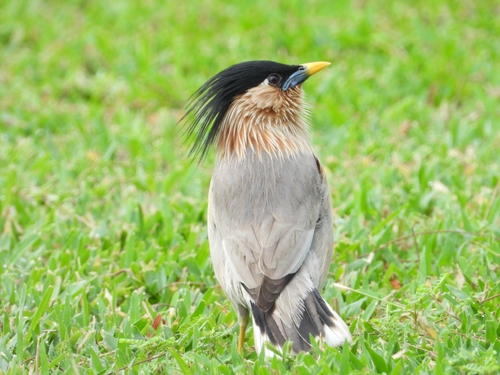
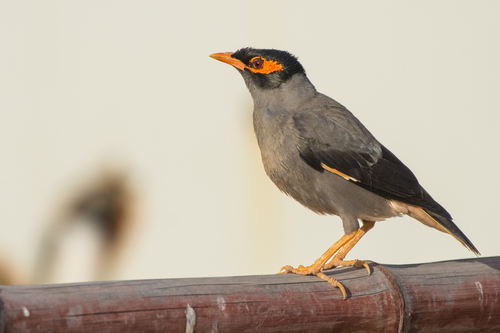
Acridotheres ginginianus, commonly called the bank myna, has black on the crown and sides of the head. Its upper plumage is slaty grey, while its underside is a lighter grey, with pale pink feathers toward the center of the abdomen. The wing is black, with a wing patch at the base of the primaries, and the tips of the outer tail feathers are pale pinkish buff. The bare skin behind the eye is brick red, legs are yellow, and the iris is deep red. Males and females cannot be told apart in the field. Young birds have a browner head and neck. This species is evolutionarily most closely related to the common myna.
The native range of the bank myna is almost entirely limited to the Indian subcontinent, stretching from the Indus Valley in the west to the Gangetic delta in the east, and lies south of the lower Himalayan foothills; it is only rarely found in sheltered Himalayan valleys. It mainly occurs near open water, and its typical habitats are cultivated farmland and open country, but flocks often live within cities, in markets and at railway stations. The species makes use of human food scraps, and will even follow catering vehicles at airports to parked aircraft. Historically, its distribution was recorded as restricted north of roughly a line between Bombay and Balasore, Orissa, but the species is now thought to be expanding its range. It is also common in the Sind and Punjab districts of Pakistan. A specimen collected from Kandahar was once the westernmost record of a vagrant individual, but the species has since become established in that region. While mostly resident, bank mynas move in response to changes in food availability and weather.
The species' scientific epithet is based on a name given by Latham, from a 1782 description by Pierre Sonnerat. Sonnerat described the bird as Le petit Martin de Gingi, referring to Gingee near Pondicherry in southern India. In 1863, Thomas C. Jerdon noted that the species did not occur in southern India, but it was recorded in the region in 1914 at Vandalur near Madras. Records of the species from further south in India have increased since 2000, and breeding colonies have been found in Assam. Bank mynas have been introduced to Kuwait, where they have established self-sustaining wild populations. Flocks have also been observed in the Maldives, Taiwan, and Japan.
Bank mynas are gregarious: they forage in flocks, breed in colonies, and roost together in trees. They will perch on livestock, and tolerate close approach when living in crowded towns, often gathering scraps in markets and garbage dumps. They are very vocal, producing a wide range of calls that include clucks, croaks, screeches, whistles, and warbling notes. Their diet consists of grain, insects, and fruits. Like the common myna, they sometimes follow grazing animals to feed on insects disturbed by the livestock, and will even eat ticks from the animals' bodies. They feed on ripening crops including sorghum, grapes, and pearl millet. They also eat a variety of insects, including some crop pests such as the castor-feeding caterpillar of Achaea janata.
The bank myna's nesting season runs from April to July or August, with most individuals breeding in May and June. Nests are always built in earthen structures: on river banks, embankments, or the sides of open wells. The species will sometimes also use holes in brick walls, and nests have also been recorded between stacked sugarcane stalks. The birds excavate the nest hole themselves; the egg chamber is sometimes located 4 to 7 feet from the entrance. Nests are lined with grass, feathers, and sometimes snake sloughs. A typical clutch holds four or five pale sky blue or greenish-blue eggs. Two broods may be raised in a single breeding season. Eggs hatch after 13 to 14 days of incubation. Nestlings open their eyes around 5 days after hatching, and fledge around 21 days after hatching. One study recorded that around 38% of eggs produced hatchlings that successfully fledged. A coccidian parasite species, Isospora ginginiana, and multiple nematode species (from genera Oxyspirura, Choanotaenia, and Hymenolepis) have been documented from this species.