About Acridotheres fuscus (Wagler, 1827)
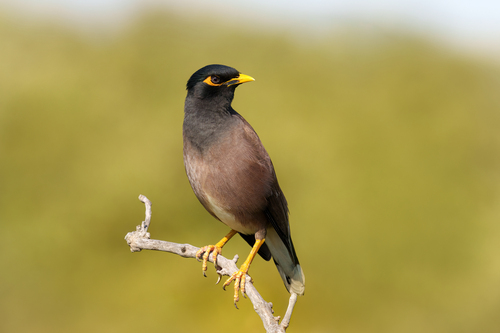
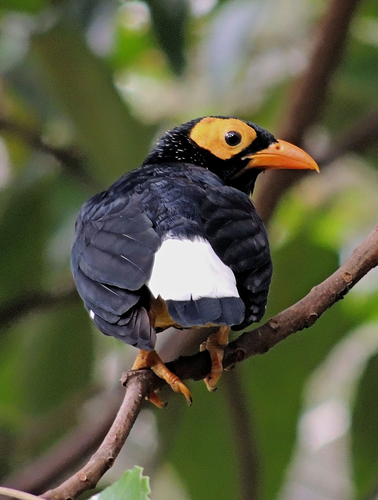
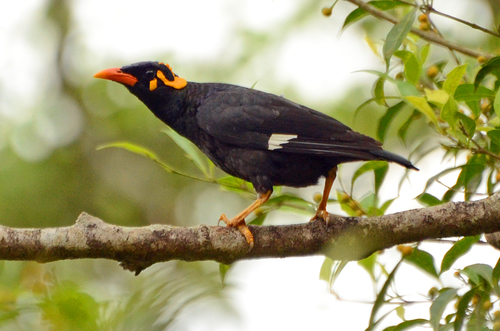
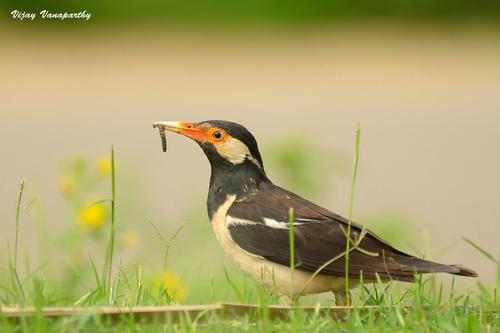
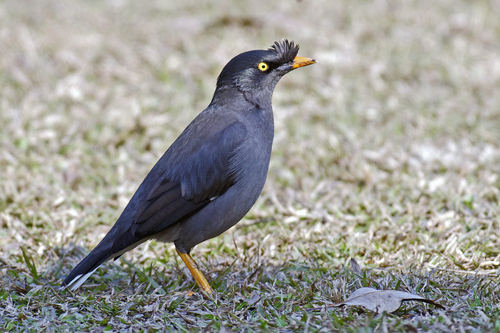
Jungle mynas (Acridotheres fuscus) measure 23 centimetres (9.1 inches) in length, and have grey plumage that is darker on the head and wings. Male and female jungle mynas cannot be distinguished by their plumage. A large white patch at the base of the primary wing feathers becomes visible when the bird is in flight, and the tail feathers have broad white tips. A tuft of feathers grows on the forehead, starting at the base of the bill. The bill and legs are bright yellow, and unlike the common myna and bank myna, there is no bare skin around the eye. The base of the beak is dark in adult birds, with a blue tint at the base of the lower mandible. The southern Indian population has a blue iris, while populations in northeastern India have a smoky dark belly and vent. Juvenile jungle mynas are browner, with a pale throat and pale colouration along the center of the underside. Abnormal leucistic plumages have been recorded for this species. The calls of the jungle myna are higher pitched than those of the common myna, and foraging flocks produce clipped cheeping contact calls. The jungle myna belongs to the Acridotheres clade, which is thought to have speciated during the late Pliocene and Pleistocene Periods. Unlike starlings in the genus Sturnus, jungle mynas do not have well-developed adaptations, including the musculature needed for prying or open bill probing that requires muscles to force the beak open. The nominate subspecies, A. f. fuscus, was originally described from Bengal by Wagler in 1827 under the name Pastor fuscus. This subspecies has a pale creamy vent, and its range extends south of the Brahmaputra into Burma and the Malay Peninsula, and it has a yellow iris. A. f. fumidus, found in eastern India mainly east of the Brahmaputra in Assam and Nagaland (with documented movements), was described by Sidney Dillon Ripley in 1950; at the time, he classified it as a subspecies of cristatellus following the prevailing treatment of the period. This subspecies has a darker smoky grey vent and can appear similar to the syntopic great myna, but the great myna is darker and lacks a pale iris. The peninsular Indian subspecies mahrattensis, described by W.H. Sykes in 1832, can be identified by its blue iris. The Malay Peninsula subspecies torquatus, described by W.R. Davison in 1892, has a white throat and a half-collar that extends around the neck. This species has a diploid chromosome number of 74, compared to 80 in the common myna. The jungle myna is a common resident breeder in tropical southern Asia including Nepal, Bangladesh, and India. Subspecies fuscus occurs across northern India west from Mount Abu, east to Puri in Orissa. It has also been introduced to the Andaman Islands and Fiji, where it was brought in around 1890 to control insect pests in sugarcane. The species has expanded on its own into some Pacific Islands such as Niuafo'ou, where it is a threat to native bird species like lories of the genus Vini, competing with them especially for nest holes. In many parts of Asia, jungle mynas are kept as pets, and feral populations have become established in many areas such as Taiwan. Breeding populations have also become established in Japan and Western Samoa. The torquatus population in Malaysia is declining, possibly because it is outcompeted by Javan mynas, with which it forms hybrids. This common passerine typically inhabits forest and cultivated land, and often occurs close to open water. Individuals may disperse outside their normal range particularly after the breeding season. Jungle mynas are omnivorous, feeding mainly on insects, fruit, and seeds, which they forage for mostly on the ground, often in the company of other myna species. They also eat berries from low bushes like Lantana, and take nectar from large flowers produced on trees such as Erythrina – their tuft feathers may act as brushes to pollinate these flowers. They also drink water that collects in the flowers of introduced trees such as Spathodea campanulata. Jungle mynas perch on large grazing mammals to pick ectoparasites off their bodies, and also capture insects that are disturbed into flight from vegetation. Flocks may follow farmers in ploughed fields, and they forage on kitchen waste in urban areas. They may catch larger prey including small mice to feed their young. In Fiji, jungle mynas have been observed anting with a millipede. The breeding season occurs in summer before the rains: from February to May in southern India, and April to July in northern India. Jungle mynas are secondary cavity nesters, using both natural tree holes and holes in man-made structures such as walls, embankments, and houses, located 2 to 6 metres above the ground. As secondary tree hole nesters, they compete with other hole-nesting species. They have also been recorded using the axils of palm fronds in Malaysia. They sometimes line the inside of their nest hole with sloughed snake skins. In the Himalayan foothills, they line their nests with dry pine needles. The usual clutch consists of 4 to 6 turquoise blue eggs. Both sexes participate in nest building, incubation, and feeding the young. They roost communally with other mynas, sometimes in sugarcane fields and reed beds. Species of the blood parasite Haemoproteus are known from jungle mynas, and the species has also been found to host Plasmodium circumflexum when artificially infected in laboratory settings. Another parasite recorded from jungle mynas is Dorisa aethiopsaris, which is found in the intestine.