About Acridotheres cristatellus (Linnaeus, 1758)
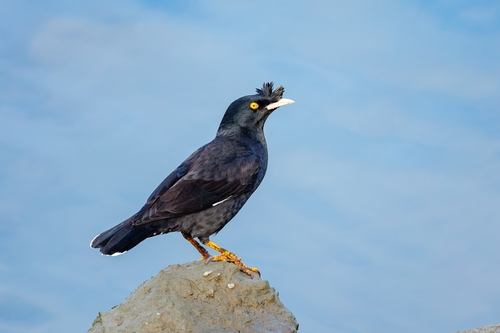
Acridotheres cristatellus, commonly called the crested myna, gets its name from the crest-shaped tuft of feathers on its forehead that covers its nostrils. This species is mostly black with a faint green sheen. It has two white patches under the wings that are more visible when the bird is in flight; the tips and bases of its primary flight feathers are white. All tail feathers except the middle pair have white tips, and its black under-tail coverts also have white tips. Adult crested mynas have orange eyes, a slender, very sharp pale yellow bill, and dull dark yellow legs. Males are slightly larger than females, and females have slightly less developed crests. There is no other sexual dimorphism between the sexes. The subspecies A. c. brevipennis has proportionally smaller wings and a smaller bill than the nominate subspecies, and its crest feathers are narrower. The subspecies A. c. formosanus is slightly smaller than the nominate subspecies; it has a greenish-yellow bill, white under-tail coverts, and a more developed crest. Newly hatched crested mynas are mostly naked, with only a short gray down covering parts of their bodies. After 18 to 20 days, juveniles are fully covered in brown feathers, and their crest is usually still not well developed. Immature crested mynas have blue-gray eyes. The crested myna occupies a wide range of both urban and rural habitats. In cities, it can be seen on building eaves, along roads and alleys, near gardens and parks, in parking lots, under bridges, in trees, in chimneys, and on roofs. In rural areas, it can be found on agricultural fields, in orchards and farmyards, and near manure piles. It often visits recently plowed fields to feed on the invertebrates living in tilled soil, and is commonly seen near cattle, eating the insects found around these animals. It also lives regularly in grasslands, open fields, and at forest edges. The species' native range extends from central and southeastern China to northern Indochina, including the Yangtze valley, southeastern Jiangxi Province, China, Burma, Taiwan, and Hainan. As a popular cage bird, it is often transported outside its native range, and has occasionally been accidentally released and introduced to new areas. In the late 1800s, it was introduced to Vancouver, British Columbia; its population grew to between 20,000 and 30,000 individuals, spreading from southern British Columbia into Washington and Oregon. By the mid-20th century, the introduced North American population began declining, and the species is now extirpated from North America. Another introduced population exists in Portugal: breeding crested mynas were first recorded near Lisbon in 1997, and the species is now established on both sides of the Tagus estuary west of Lisbon and on the Setúbal Peninsula. The crested myna has also been successfully introduced to Penang, Singapore, Manila, parts of Japan, and parts of Argentina. In the Philippines, this species is called "Martinez". Crested mynas build their nests in a variety of locations. In forests, they build nests in holes left by woodpeckers or created by decay. In urban areas, nests are commonly found in chimneys, drains, and crevices, among other spots. Most nest building occurs in April or May, and both males and females help construct the nest. Crested mynas use almost any material they can find to build their nests, including grass, branches, and garbage. The first clutch of the season is laid in late April or May. Most breeding pairs are double-brooded, producing a second clutch in the same breeding season, which is laid between June and mid-August. The eggs are light blue-green, and shaped similarly to robin eggs. Clutch size is typically 4 to 6 eggs, with one egg laid per day. Hatchlings are altricial when they hatch. Eggs are incubated for 14 days. After hatching, fledglings leave the nest to move to a nearby tree or shrub, and their parents continue feeding them for approximately one week. Young crested mynas do not separate from their parents immediately; they typically stay together in small family groups, which join larger flocks for feeding and traveling.