About Acraea rahira Boisduval, 1833
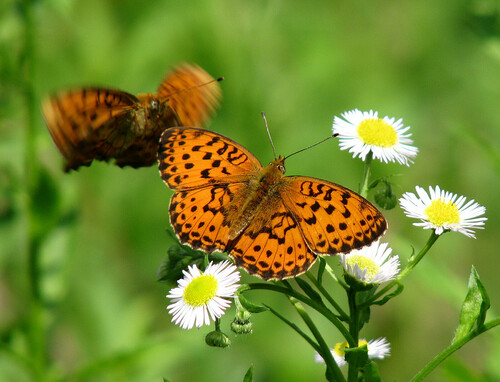
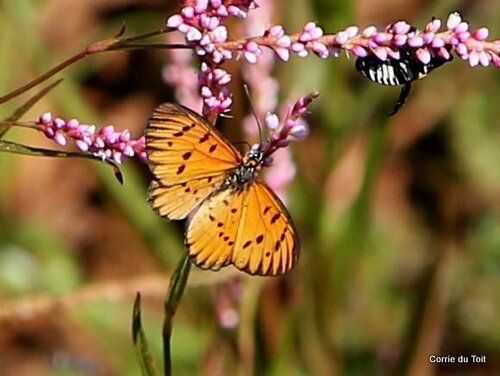
Acraea rahira, first described by Boisduval in 1833, has a wingspan of 35–40 mm for males and 40–50 mm for females. The upper surfaces of both wings are light grey-yellow in males and light grey in females. The veins in the distal portion of the wings are edged with black, and widen into long triangular or rounded spots at the distal margin. Basal and discal dots are free-standing and distinct. On the hindwing, discal dots 1b through 5 are arranged in an almost straight line, and discal dots 6 and 7 form a nearly right angle with this line. The under surface of the wings is similar in pattern to the upper surface, but is somewhat lighter, and has reddish streaks in areas 1b, 1c, and the cell between the basal and discal dots. Distal to the discal dots runs a whitish transverse band around 2 mm in breadth, from area 1a through 5, and this band is bordered basally by a dark line. The dark line ends at vein 5 or 6, and is also more or less visible on the upper wing surface; it corresponds to the proximal boundary of the marginal band. The marginal band barely differs in color from the wing's ground color, or has some reddish streaks in the interneural folds. At the distal margin, the ground color is an even lighter yellow, but does not form distinct marginal spots, and the proximal boundary of these spots is either entirely absent or only very indistinct. The larva is blackish with yellow thoracic legs, a yellow lateral line, and a white dorsal line. Its spines are short, yellow, and situated on yellow spots; its head is also yellow. Larvae feed on Erigeron. The pupa is whitish with black markings. This well-distinct species prefers damp and marshy habitats, and ranges across all of South Africa, extending north to Angola and Rhodesia.