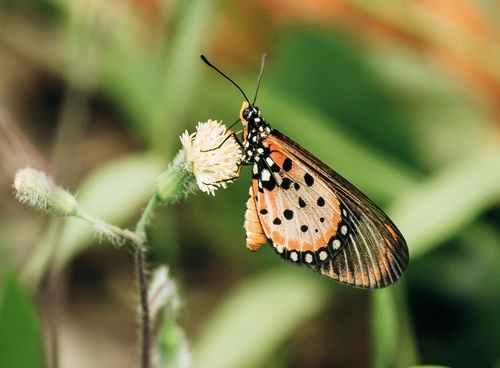
About Acraea neobule Doubleday, 1847
This species, Acraea neobule, was first described by Doubleday in 1847. The nominal form, A. neobule neobule, has forewings that are thinly scaled with light orange-yellow or ochre-yellow on the upper surface, extending to the discal dots in cellules 4 to 6, and often also at the distal margin in cellules 5 to 8; the rest of the apical region is hyaline. A spot beyond the middle of the cell, a transverse streak at the end of the cell, and the discal dots are often distinct, though the discal dots in cellules 2 and 3 are not infrequently absent. On both upper and lower surfaces, the hindwing is orange-yellow with distinct discal dots; the discal dot in cellule 4 sits closer to the distal margin than all other discal dots. It has a marginal band 1 to 1.5 mm wide that bears rounded light-colored marginal spots. This nominal form ranges across South and East Africa, extending to Angola, Zimbabwe, Sudan, and Ethiopia. The subspecies or race seis Feisth. has forewings scaled yellow all the way to the distal margin in cellules 1a to 2, and has distinct yellow marginal spots in cellules 3 to 8, leaving only a hyaline subapical band in cellules 3 to 6. Occasionally, the yellow base color is replaced by black-grey or dark brown, especially in females. This race occurs from Senegal to Nigeria, particularly in the country's interior. The race zambesina Auriv. is very similar to the nominal neobule, but its forewing is completely scaled with red-yellow and lacks a diaphanous subapical area. Instead it has a narrow marginal band 1 mm wide, which widens triangularly at the ends of the veins. The discal dots on both wings match those of nominal neobule, but on the underside of the hindwing, the white basal dots are smaller and nearly uniform in size. This race is found in Mozambique, from Zumbo to the Zambezi River. The race arabica Rbl. completely matches the race seis in the appearance of its upper wing surfaces. It differs from all other forms of neobule in that the basal dots on the underside of the hindwing are smaller and positioned entirely separately from one another. The marginal spots of the hindwing are small and elongate, almost matching the shape seen in Acraea horta. This race occurs in South Arabia. The wingspan of this species is 48–55 mm for males and 50–56 mm for females.