About Acraea igola Trimen, 1889
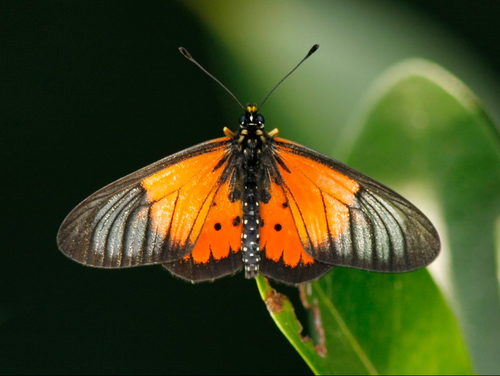
Acraea igola Trimen, 1889 is very similar to two related species, Acraea quirinalis and Acraea orestia, but can be distinguished by two key traits: the marginal band of its hindwing is not transparent, and its wing cell has no spots.
The basal half of the forewing, extending to the apex of the cell and vein 3, is bright orange-yellow and lacks spots. The costal margin is dusted with black all the way to the base; the apex, marginal band, and veins 3 through 6 are also black. Cellules 3 through 6 are diaphanous otherwise. The upperside of the hindwing is orange-yellow, marked with black dots and a black marginal band 2 to 2.5 millimeters broad. On the underside of the wing, the red-yellow base color is much paler than it is on the upperside. Streaks along the interneural folds are short and do not reach the distal margin.
In female specimens of the type form, the ground color is lighter, ranging from light ochre-yellow to cream-yellow, and the marginal band is not sharply defined.
The female form maculiventris Sm. & Kirby, which occurs alongside the type form, has a duller, more brown-yellow ground color, and the marginal band on the upperside of the hindwing is not sharply defined, varying from sometimes broader to sometimes narrower than the type form. On the underside of the hindwing, the color may match that of the upperside, or the base may be chocolate-brown extending out to the discal spots, transitioning to light reddish color up to the red-brown marginal band.
This species occurs from Zululand to German East Africa.