About Acraea horta Linnaeus, 1764
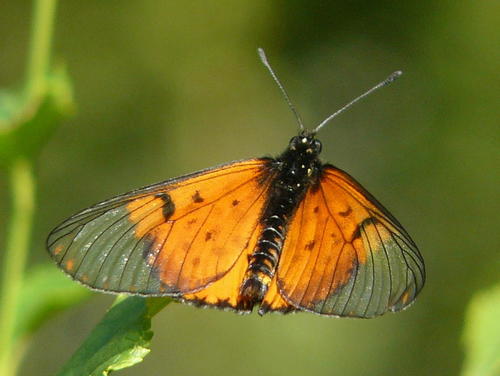
Acraea horta Linnaeus, 1764 (A. horta L., shown as 53 e, f) is one of the longest-known and most common Acraeids in the Cape region. It is also native to Pondoland, Natal, Zululand, Transvaal, and Zimbabwe. Males have a typical wingspan of 45–50 mm, while females have a typical wingspan of 49–53 mm. Males are similar in appearance to males of Acraea neobule, but differ in that the black dots on the fore wing are either absent, or only represented by one dot in the cell and an additional dot in area 1b; the marginal spots of the hind wing are small, elongate, and incompletely separated from the wing's ground colour; and the underside of the hindwing is red along the inner margin and in the marginal band. In females, the forewing is almost entirely hyaline; the upperside of the hindwing is light yellow to grey-yellow, while the underside is whitish with larger marginal spots bounded by distinct lunules. The larva is brown-yellow with black transverse lines, and seven yellow lateral and dorsal lines; the larva's head and spines are black. Larvae feed and develop on Kiggelaria africana and various Passiflora species. The female aberration conjuncta Blachier is distinguished by having the discal dots of the hindwing transformed into long, broad black stripes.