About Acraea cabira Hopffer, 1855
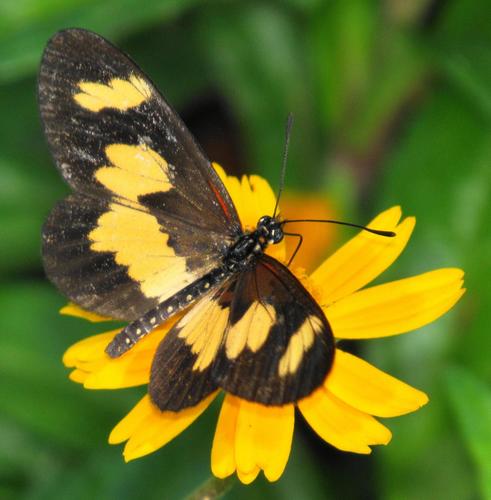
Scientific name: Acraea cabira Hopffer, 1855 Description. The wingspan measures 38–44 mm (1.5–1.7 in) for males and 40–45 mm (1.6–1.8 in) for females. Males and females are very similar in color. The upper surface of the wings is nearly black, with large yellow patches on both the forewing and hindwing. There is some reddish brown coloring on the veins near the base of the forewings. The underside has yellow patches that match those on the upper surface. The base of the wing's undersurface has orange-brown markings with black spots. The wing margin on the undersurface has black lines against an orange-brown background. Technical Description. A. cabira can be identified by the hindmarginal spot on the upper side of the forewing that completely covers the base of cellule 2, and also reaches the cell in 1 b. The light spot in 1 b is cut off obliquely on its proximal end, so it is much narrower at vein 1 than at vein 2, giving the hindmarginal spot a distinct shape. The median band of the hind wing is widened in cellules 4 and 5. On the under surface of the hindwing, there are always broad red streaks in the cell, in cellule 8, and at the distal margin. The whitish marginal spots here extend proximally into red, black-edged streaks, and the veins are bordered by grey lines. The underside of the forewing is reddish to yellow-brown in the cell and at the base of cellule 1 b. In the typeform cabira Hpff., the upper surface markings are light yellow, and the hindmarginal spot of the forewing above is prolonged more or less basad along the hindmargin of the cell. In the figured specimen (56 c), this prolongation is so small that the example belongs rather to natalensis. This form ranges from Congo to the Cape and Uganda. Form apecida Oberth. (56 c) only differs in having the median band of the hindwing and the hindmarginal spot of the forewing more or less suffused with red; occasionally the subapical band of the fore wing is also reddish. It is found in Congo and German East Africa. Form abrupta Grunb. matches apecida in upper surface traits, but differs on the underside: the marginal band of the hindwing is almost uniform black without light and dark streaks, and the red spots between the basal dots are absent. It occurs on the Sesse Islands. Form natalensis Stgr. (56 c) only differs from the type-form in that the hindmarginal spot on the upper side of the forewing is not prolonged towards the base, and instead terminates at the origin of vein 2. Its range extends from Natal to German East Africa. Aberration biraca Suff. differs in that the hindmarginal spot on the upper side of the forewing is prolonged in 1 b to the base. It is found in Nyassaland. Distribution. It is found from the eastern subtropical forest areas of South Africa, through Eswatini, Zimbabwe, to Uganda, the Congo and Kenya.