About Acorus calamus L.
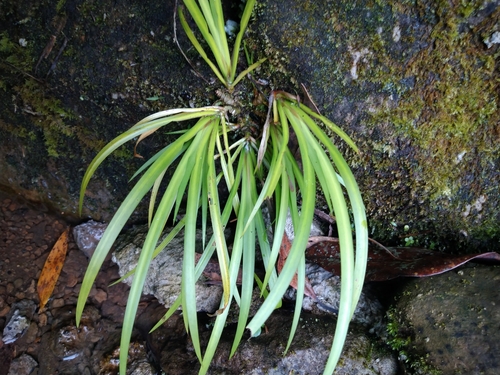
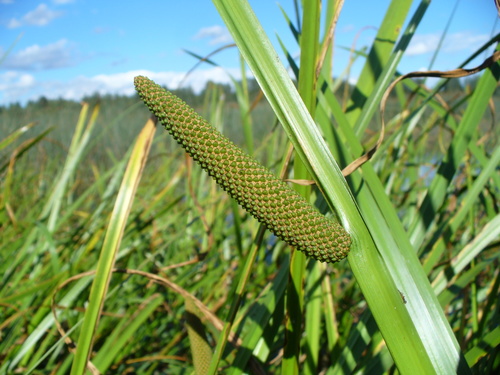
Acours calamus L., commonly called sweet flag, is a herbaceous perennial plant that reaches up to 2 meters (79 inches) in height. Its leaves are similar in appearance to leaves from the iris family. Sweet flag grows in tufts of basal leaves that emerge from a spreading rhizome. The leaves are erect, yellowish-brown, and radical, with pink sheathing at their bases. They are sword-shaped, flat and narrow, tapering to a long, sharp point, and have parallel veins. The leaf edges are smooth, and can be wavy or crimped. Sweet flag can be told apart from irises and other similar plants by its crimped leaf edges, the fragrant scent it releases when crushed, and its production of a spadix. Only sweet flag plants that grow in water produce flowers. Solid, triangular flower stalks grow from the axils of the outer leaves, and a semi-erect spadix emerges from one side of the flower stem. The spadix is solid, cylindrical, tapering at both ends, measures 5 to 10 cm in length, and lacks the covering spathe common to other plants in the Araceae family. It is densely packed with tiny greenish-yellow, sweetly fragrant flowers. Each flower holds six petals and six stamens enclosed in a six-divided perianth, surrounding a three-celled, oblong ovary with a sessile stigma. In Europe, sweet flag flowers for about one month in late spring or early summer, but does not produce fruit. In Asia, it also produces fruit only sparingly, and reproduces mainly through rhizome growth to form large colonies. The fruit is a mucus-filled berry that falls into water when ripe and disperses by floating. The rhizome is branched, cylindrical, and knobby, about as thick as a human finger, with numerous coarse fibrous roots growing below it. The outer surface of the rhizome is brown, while the inner tissue is white. Sweet flag is native to the Irtysh River valley in Kazakhstan, but has been widely introduced across the world. It grows in wetland habitats, including the edges of small lakes, ponds and rivers, marshes, and swamps. Acorus calamus and products made from it, such as its oil, were banned for use as human food or food additives in 1968 by the United States Food and Drug Administration. The European Commission issued a 2001 ruling that recommended a daily consumption limit of 115 micrograms in food or alcoholic beverages, but did not define a level of safe exposure. While calamus has long been used for its fragrance and consumed by people, it has not been tested through rigorous clinical research. Individual medical reports of toxicity note severe nausea and prolonged vomiting lasting many hours after oral use. Laboratory studies of plant extracts have found other forms of toxicity, caused mainly by the emetic compound β-asarone. The plant is claimed to be psychoactive (hallucinogenic), but all experiments done with American calamus have been completely unsuccessful, even trials using very high dosages of up to 300 grams of rhizomes. Acorus calamus has been traded across many cultures for centuries. It has been used in traditional medicine to treat a range of ailments, and the aroma of its essential oil is used in the perfume industry. In Europe, rhizome essence is used as a flavoring for foods, alcoholic beverages, and bitters, and the plant was once used to make candy. Young stalks under 30 cm (12 inches) tall can be pulled, and their inner stems eaten raw. Rhizomes can be washed, peeled, cut into small pieces, boiled, and simmered in syrup to make candy. It has a long history of use in Chinese, Nepalese, and Indian herbal traditions, and is still used in herbalism by the Chipewyan people.