About Aconitum tauricum Wulfen
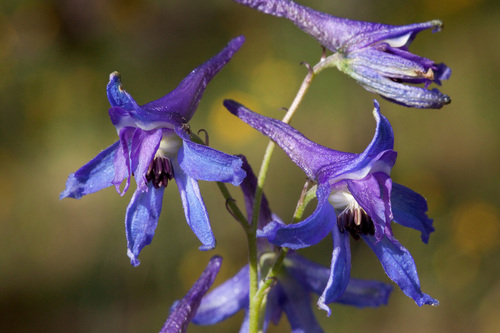
Aconitum tauricum is a perennial forb that grows from non-globose rhizomes. It is a tall, spindly plant with a growth habit that ranges from erect to scandent (vine-like climbing). Its leaves are divided, and faintly visible net-like veins appear on the underside of stem leaves. Flowering occurs primarily from August to October. The inflorescence is paniculate, and it may be simple or branched with a small number of side branches. The perigon is blue or purple. The helmet-shaped structure of the flower is typically wider than it is high. The outer surfaces of the tepals are hairless. Flower stems have upright gland hairs; they may be hairless overall, or only have protruding glandular hairs beneath the flower. The linear bracteoles are either hairless or hairy, and measure 3 to 7 millimeters long, rarely reaching 2 millimeters. The nectar leaves may be either hairless or hairy. This plant reaches an average stature height of around 0.8 meters. Pollination is carried out by insects, including species of Bombus (bumblebees) and other insect groups. Its fruits are pod-like follicles, and fully ripe seeds are black. Aconitum tauricum is poisonous because it contains alkaloids such as aconitine. This wildflower is native to Europe, where it occurs in Austria, Germany, Romania, Ukraine, and Yugoslavia. It grows in alpine and subalpine areas, and its typical habitats include meadows and tall herbaceous vegetation.