About Aconitum napellus L.
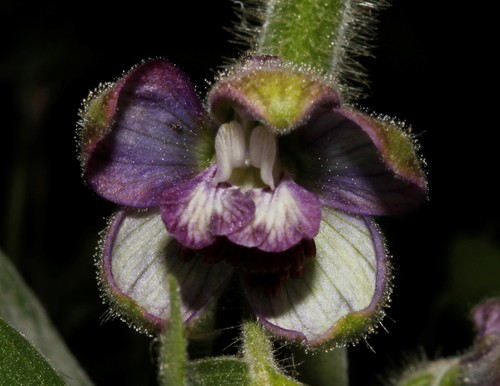
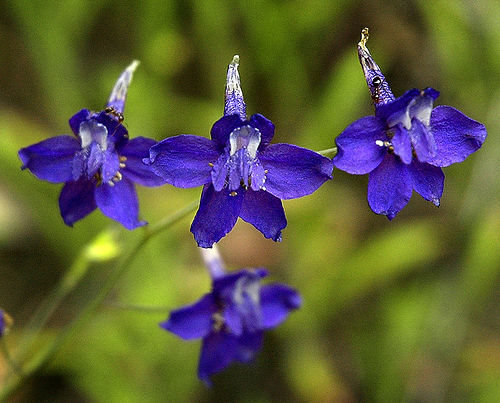
Aconitum napellus L., commonly known as monkshood, aconite, Venus' chariot, or wolfsbane, is a highly toxic flowering plant species in the genus Aconitum of the family Ranunculaceae. It is native and endemic to western and central Europe. This herbaceous perennial grows to 1 m (3 ft 3 in) tall, with hairless stems and leaves. The leaves are rounded, with a diameter of 5–10 cm (2.0–3.9 in), and palmately divided into five to seven deeply lobed segments. The flowers are dark purple to bluish-purple, narrow oblong and helmet-shaped, and 1–2 cm (0.39–0.79 in) tall. Plants native to Asia and North America that were formerly classified as A. napellus are now recognized as separate species. This plant is extremely poisonous whether ingested or touched, and is the most poisonous plant found across Europe. Aconitum napellus is cultivated in gardens across temperate zones for its spiky, showy inflorescences that bloom in mid-autumn, as well as its attractive foliage. Cultivated varieties also include forms with white and rose-colored flowers. The cultivar 'Spark's Variety' has received the Royal Horticultural Society's Award of Garden Merit. Beyond ornamental garden planting for its attractive spike-shaped inflorescences and showy blue flowers, Aconitum napellus is grown as a cut flower crop, used for fresh cut arrangements and sometimes for dried floral material. Under cultivation, the species has a low natural propagation rate. It is propagated either by seed, or by removing offsets that grow annually from its rootstocks. Micropropagation protocols for this species have been studied for cultivation. This species has been crossed with other Aconitum species to produce attractive hybrids for garden use, including Aconitum × cammarum. Like other species in the genus, A. napellus contains multiple poisonous compounds, including potent cardiac poison. In ancient times, this poison was used to coat spears and arrows for hunting and battle. Persian physician Avicenna, who lived from 980 to 1037 CE, recorded that arrows dipped in the plant's sap were used to kill animals. Dr Antonio Guaineri noted in Practica, one of the first medical dictionaries, that arrows poisoned with toxin from this plant's roots were used to hunt wild goats in Italy. A. napellus has a long history of use as a poison, with recorded cases stretching back thousands of years. During the ancient Roman period in Europe, the plant was often used to kill criminals and enemies. By the end of the Roman period, its cultivation was banned, and anyone caught growing A. napellus could be legally sentenced to death. More recently, aconites including this species have been used in murder plots. They contain the highly toxic chemical alkaloids aconitine, mesaconitine, hypaconitine, and jesaconitine. Aconitum napellus was also featured as a plot element in a recent Sherlock Holmes novel.