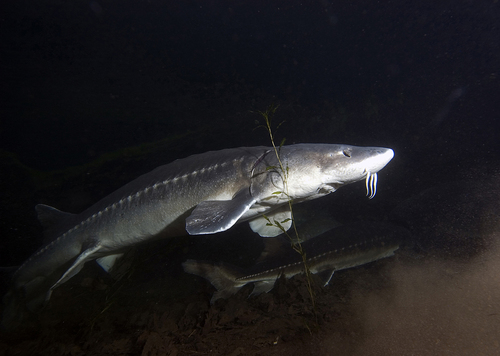
About Acipenser transmontanus Richardson, 1836
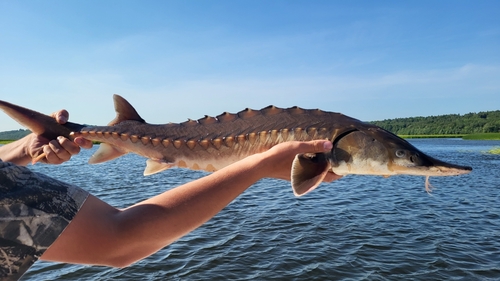
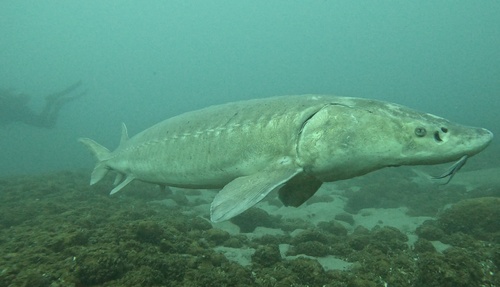
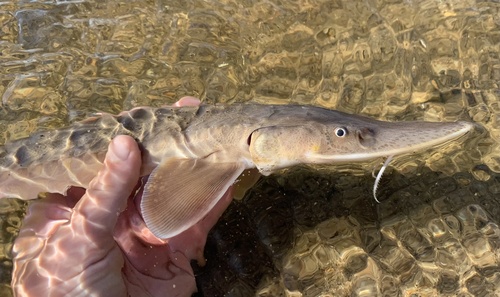
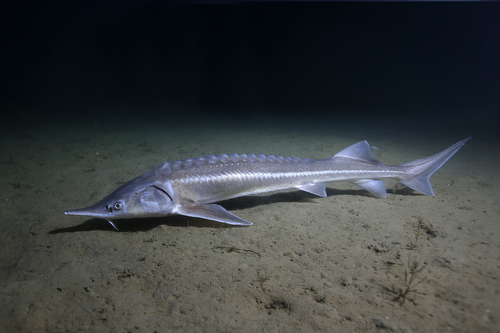
Acipenser transmontanus (white sturgeon, previously referenced as S. transmontanus) can be distinguished by two rows of four to eight ganoid bony plates between the anus and anal fin, and its dorsal fin has approximately 45 rays. Its dorsal side coloring ranges from gray to brownish, its ventral side is paler, and its fins are gray. Its barbels are located anterior to the mouth, positioned closer to the snout than the mouth. At sexual maturity, this species can reach 1.6 m (5.2 ft) in length; the maximum recorded length across any age class is 6.1 m (20 ft), and common adult lengths are around 2.1 m (6.9 ft). While the age at maturity is not certain, known documented specimens of this species range from 11 to 34 years old. The most verified record of this species' maximum weight is 630 kg (1,390 lb); unauthenticated records report higher estimates, including an 816 kg (1,799 lb) estimate for an individual reportedly aged 104 years. A 1995 study sampled adults that weighed between 34 and 75 kg (75 and 165 lb). A relatively recent record from California documents a 210 kg (460 lb), 2.8 m (9.2 ft) specimen considered the largest recorded in the state in recent years. White sturgeon are native to several large North American rivers that drain into the Pacific Ocean. They primarily live in large river estuaries, but migrate upstream into freshwater to spawn, and travel long distances between different river systems. Reproducing populations have been documented along the West Coast, from northern Mexico north to the Aleutian Islands in Alaska. They are commonly found in deep, soft-bottomed areas of estuaries, and their movement within the water column depends on salinity. Historical ranges of the species have been substantially altered by overharvesting, habitat changes caused by dams, and river regulations, all of which impact habitat quality, suitability, and connectivity. In the lower Fraser River, British Columbia, researchers assess white sturgeon movement and abundance using acoustic tags and mark-recapture methods. Although the model developed by Robichaud, English and Nelson assumes a closed, homogeneous population, data from acoustic tags and mark-recapture shows that white sturgeon are sedentary during winter and mobile in spring and fall. Data indicates they leave the Fraser River and enter the Strait of Georgia during mobile periods, a conclusion that has been validated by microchemical evidence of marine exposure in fin rays from Fraser River white sturgeon. Hydroelectric dam construction alters the seasonal movement of white sturgeon across many river systems, and the Columbia River Basin has seen major shifts in sturgeon distribution and movement caused by dams. Dams in the basin have largely blocked sturgeon upstream movement, because fish ladders on these dams are designed primarily for salmon and steelhead. While downstream passage of sturgeon through the dams has been reported, the exact route of passage has never been identified. Downstream movement through dams is only possible through operating turbines, open spill gates, and the ice and trash sluiceway. White sturgeons are iteroparous breeders. According to Kohlhorst 1976, their spawning period in the Sacramento and San Joaquin Rivers runs from mid-February to late May, with peak spawning activity in March and April. There is significant uncertainty about the timing of reproductive events for white sturgeon, and many studies report different results depending on which river system was observed. Chapman, Van Enennaam and Doroshov observed sexually mature females measuring 950 mm (3.12 ft) fork length in the Sacramento-San Joaquin River system that were estimated to be around nine years old using the Von Bertalannfy growth function, while the youngest sexually mature individual recorded was a male measuring 750 mm (2.46 ft) FL estimated to be six years old. However, other reports place sexual maturity for white sturgeon at twelve years old for females and ten years old for males. Uncertainty in age estimates derived from fin ray annuli may explain these discrepancies. It is thought that spawning occurs every two to four years for females, and every one to two years for males. Behavior during spawning is not well documented, but it is known that white sturgeon are communal broadcast spawners: a single female's eggs are fertilized by many males. When ready to spawn, white sturgeon choose spawning substrates that vary by river system, spawning on gravel or rocky substrate in moderate to fast currents. Observed spawning depths range from 3–23 m (9.8–75.5 ft), and recorded bottom water velocities in spawning areas range from 0.6 to 2.4 m/sec. After a female releases eggs, the eggs are negatively buoyant. They develop an adhesive coat when they contact water, which allows them to attach to the substrate near the spawning site. Hatching time is temperature-dependent, and can range from 3 to 13 days. The optimal hatching temperature is between 14 and 16 °C (57 and 61 °F); mortality is observed at temperatures below 8 °C (46 °F) and above 2 °C (36 °F).