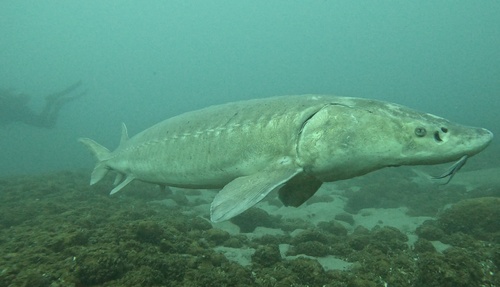
About Acipenser fulvescens Rafinesque, 1817
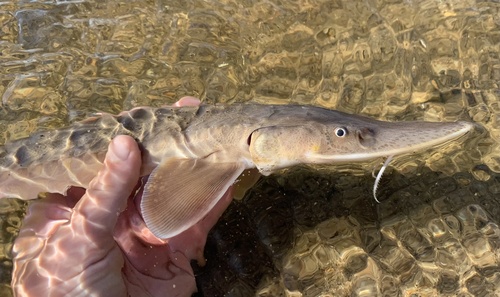
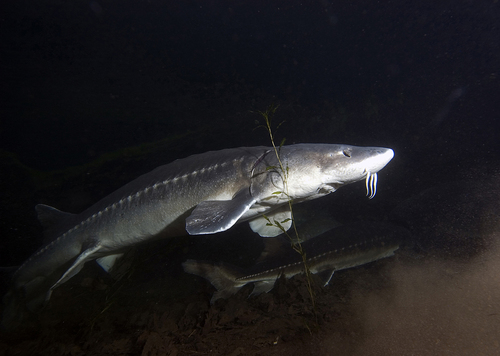
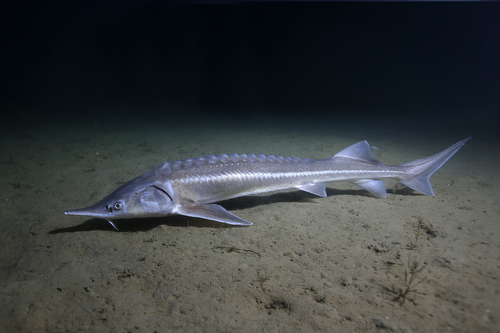
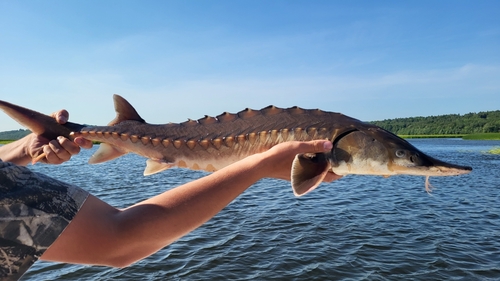
The lake sturgeon (Acipenser fulvescens Rafinesque, 1817) has taste buds on and around its barbels, which sit near its rubbery, prehensile lips. It extends these lips to suck up soft live food, and swallows prey whole because it has no teeth. Its typical diet includes insect larvae, worms (including leeches), and other small, primarily metazoan organisms it finds in mud. Some populations have fish as a significant part of their diet, a shift that has occurred largely since the invasive round goby was introduced in the early 1990s. Because this large species survives by feeding on very small organisms, its feeding ecology has been compared to that of large filter-feeding marine animals such as some whales. This species is distributed across much of central and eastern North America. It lives in the Mississippi River drainage basin, ranging south to Alabama and Mississippi and east to the French Broad River in western North Carolina. It also occupies the Great Lakes, the Lake Winnebago System, and the Detroit River, extending east down the St. Lawrence River to the furthest extent of fresh water. In the west, its range reaches Lake Winnipeg and the North Saskatchewan and South Saskatchewan Rivers. In the north, it can be found in the Hudson Bay Lowland. In the east, it inhabits Lake Champlain and several Vermont waterways, including the Winooski, Lamoille, and Missisquoi rivers, as well as Otter Creek. This current distribution aligns with the range of large proglacial lakes that formed as glaciers retreated from North America at the end of the last ice age, such as Lake Agassiz and Lake Iroquois, which once connected all these areas. Lake sturgeon often migrate to search for food, find suitable spawning sites, or respond to seasonal environmental changes. Juveniles typically live in pools deeper than around 6 feet, while adults usually occupy deep water in large lakes. Most individuals do not stray far from appropriate spawning locations, and the availability of plentiful prey is also a major factor in habitat selection. Lake sturgeon have a very long lifespan. Males typically live up to 55 years, while females can live between 80 and 150 years. They grow quickly during their extended juvenile stage. For reproduction, male lake sturgeon usually reach sexual maturity between 8 and 12 years old, though some take as long as 22 years. Females reach sexual maturity between 14 and 33 years old, most often between 24 and 26 years. These sturgeon spawn on clean gravel shoals and in stream rapids, usually between April and June. They prefer spawning in water temperatures between 55 and 64 °F (13 and 18 °C). To reproduce, lake sturgeon swim in circles around each other before shaking violently. After the male finishes circling and releases his sperm, the female lays her eggs. Females produce 4,000 to 7,000 eggs per pound of their body weight. Males spawn every 2 to 7 years, while females spawn every 4 to 9 years. Only 10 to 20 percent of adult lake sturgeon are sexually active in any given season. Lake sturgeon are polygamous, which maximizes their genetic diversity.