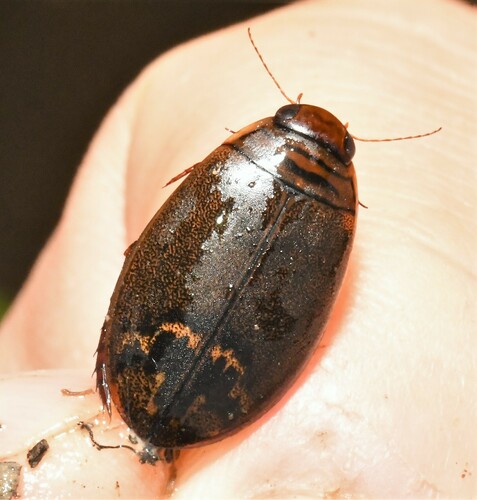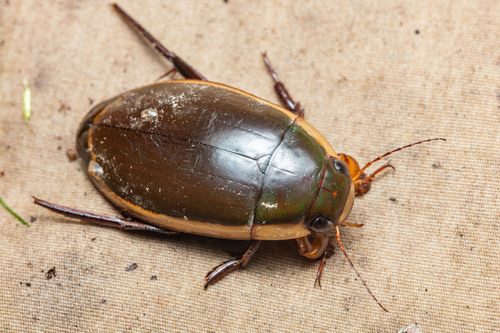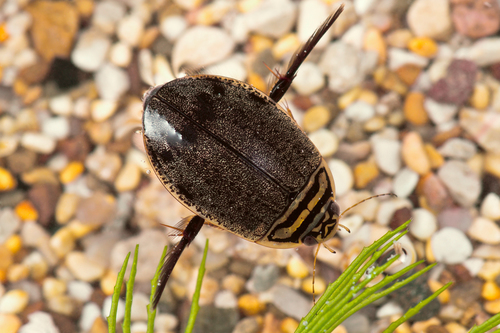
About Acilius sulcatus (Linnaeus, 1758)
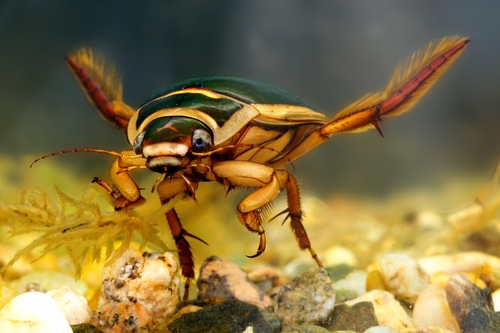
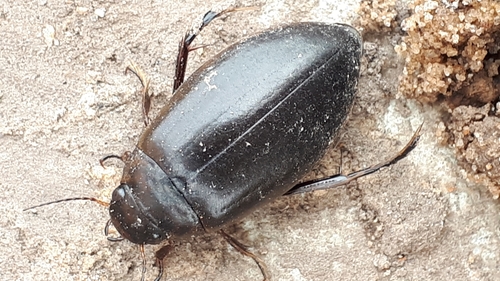
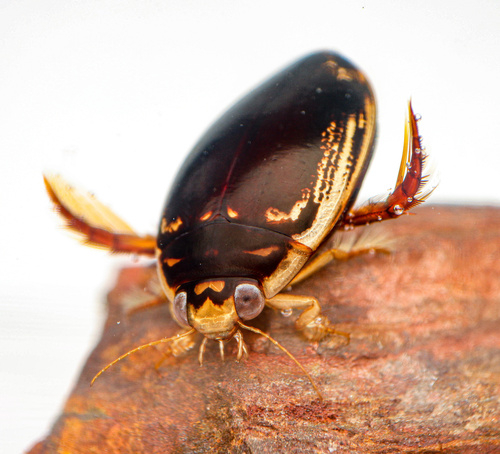
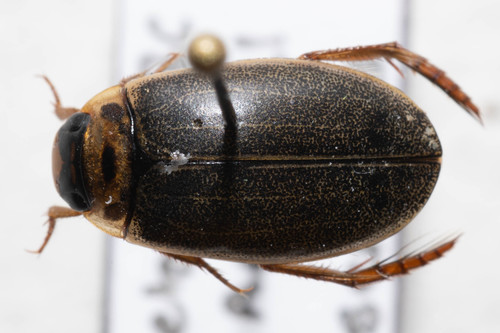
Scientific name: Acilius sulcatus (Linnaeus, 1758). Morphology: Color of Acilius sulcatus varies across its entire range, so it is not a reliable identifying characteristic. However, this species has many unique structural features that are useful for identification. It is easily recognized by its large, distinctive hind legs. The hind legs are long and fringed with setae, forming a paddle-like shape when spread. Its body is always wider than it is tall, and it has a streamlined shape, with no spines or other protruding chitinous structures. Like all Dytiscidae beetles, A. sulcatus lacks a sternal keel. A. sulcatus is clumsy on land, but it is well adapted to an aquatic lifestyle and is a strong flier. This species can also be identified by its unique reproductive structures. Males have three ventral suction disks that hold the male in place on the slippery female during reproduction. Male attachment to females reduces female survival, because the mating period can attract predators. To avoid this potential death, females have modified elytra. The female elytra are highly grooved with many suberect setae, which makes male attachment far more difficult. Male elytra are smooth and lack setae, resulting in high levels of sexual dimorphism. Competition between the sexes has led to an evolutionary sexual arms race in this species. Range: A. sulcatus has a worldwide distribution, but occurs primarily in Northwestern Europe. Habitat: It lives in both temporary and permanent water bodies. A. sulcatus is a generalist in its habitat choice, living in bogs, ponds, streams, and similar habitats. Because A. sulcatus can fly, it is not restricted to a single body of water. It occurs in water bodies with both high and low levels of vegetation, showing no preference between the two. These beetles dominate in water bodies without fish predators, and are used as a primary indicator of predator presence. Life cycle: A. sulcatus is univoltine, with adults overwintering in deep permanent water bodies that do not dry out or freeze completely. Mating pairs are found in both spring and autumn. Females lay their eggs near water on the underside of plant matter. Eggs hatch after approximately one week. Larval development takes about 30 days, and pupal development takes an additional 16 to 28 days.