About Achillea millefolium L.
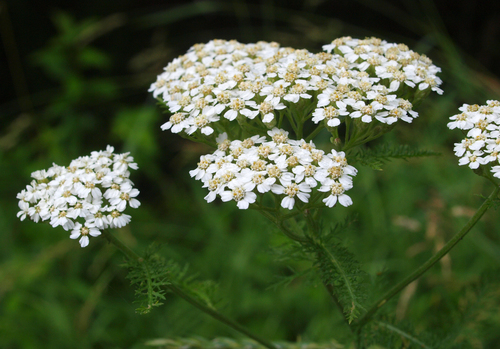
Achillea millefolium L. is an erect, herbaceous perennial plant that grows one to several stems between 0.2 and 1 metre (8 to 40 inches) tall, with a spreading, rhizomatous growth form. Its leaves are cauline and more or less clasping, arranged spirally and evenly along the stem, with the largest, most petiolate leaves located toward the base. Leaves are 5 to 20 centimetres (2 to 8 inches) long, fernlike, and divided bipinnately or tripinnately. The inflorescence has 4 to 9 phyllaries and holds both ray and disk flowers that range from white to pink, with blooming occurring from March to October. There are typically 3 to 8 ray flowers, which are 3 millimetres (1⁄8 inch) long and shaped ovate to round. The tiny disk flowers number between 10 and 40 per inflorescence. Inflorescences form flat-topped clusters of capitula, are visited by many insect species, and have a generalized pollination system. The small achene-like fruits of this plant are called cypsela. Achillea millefolium has a distinct spicy scent that remains when the plant is dried, and it may be irritating to some people. Yarrow is native to temperate regions of the Northern Hemisphere, and is found in Europe, Asia, and North America. It grows at elevations ranging from sea level to 3,500 m (11,500 ft). Common yarrow is frequently found in the mildly disturbed soil of grasslands and open forests, and its active growth occurs in the spring. In North America, both native and introduced genotypes, and both diploid and polyploid plants occur. It is found in every habitat throughout California except the Colorado and Mojave Deserts. Common yarrow produces an average yield of 110,000 plants per hectare (43,000 per acre), with a total dry weight of 11,800 kg per hectare (10,500 pounds per acre). It has been introduced as livestock feed in New Zealand and Australia, where it is a common weed in both wet and dry areas, including roadsides, meadows, fields and coastal places. Several cavity-nesting birds, including the common starling, use yarrow to line their nests. Experiments conducted on tree swallows, which do not naturally use yarrow, show that adding yarrow to nests inhibits the growth of parasites. Achillea millefolium is a food source for many insect species, including the larvae of a number of moths, though it is not particularly attractive to ladybirds. The mite Aceria kiefferi (Nalepa, 1891) causes galls on A. millefolium. Yarrow can cause allergic skin rashes. According to the American Society for the Prevention of Cruelty to Animals, yarrow is toxic to dogs, cats, and horses, causing increased urination, vomiting, diarrhea and dermatitis. When consumed by cows, it gives an unfavorable flavor to their milk. Achillea millefolium is cultivated as an ornamental plant by many plant nurseries. It is planted in gardens and natural landscaping settings across diverse climates and styles, including native plant gardens, drought-tolerant gardens, and wildlife gardens. It is a frequent component of butterfly gardens. The plant prefers well-drained soil in full sun, but can be grown in less ideal conditions. A. millefolium was used in traditional medicine, in part for its astringent properties and the mild laxative effect of its leaves. It was used in ancient times to heal wounds and stop bleeding, and in the 16th century, crushed yarrow leaves were used to stop nosebleeds. North American varieties were traditionally used by many Native American nations. The Navajo considered it a "life medicine", chewed the plant for toothaches, and used its infusions for earaches. The Miwok in California used the plant as an analgesic and a remedy for head colds. Native American nations used the plant to heal cuts and abrasions, relieve earaches and throat infections, and as an eyewash. Yarrow was used by Plains indigenous peoples to reduce pain or fever and aid sleep. Some Ojibwe people used a decoction of yarrow leaves on hot stones, inhaling the steam to treat headaches, or applied root decoctions to the skin for a stimulating effect. The entire plant is reportedly edible and nutritious, but it is advised that people do not consume large amounts. The foliage is pungent, and both leaves and flowers are bitter and astringent. Young leaves can be eaten raw and added to salads. Leaves, which have an aniseed-grass flavor, can be brewed as tea. In the Middle Ages, yarrow was part of a herbal mixture known as gruit used to flavor beer before the use of hops became common. However, medieval Dutch and German city accounts from the gruit region do not mention yarrow. Swedish biologist Linnaeus noted that the Dalecarnians infused this herb in beer. Flowers and leaves are still used to make some liquors and bitters today. Yarrow is used as a companion plant, attracting some beneficial insects and repelling some pests. A. millefolium can be planted to combat soil erosion because it has good drought resistance. Before monocultures of ryegrass became widespread, both grasslands and pastures contained A. millefolium at a density of about 0.3 kg per hectare. One factor that led to its inclusion in grass mixtures was its deep roots and mineral-rich leaves, which minimize mineral deficiencies in ruminant feed. It was introduced into New Zealand as a drought-tolerant pasture. Yarrow can be used to dye wool, and the resulting color ranges from green to yellow depending on the mordant used.